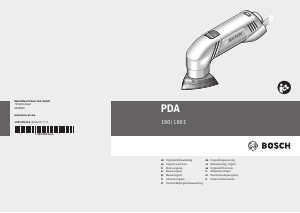
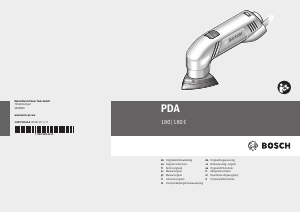
Manual de uso Bosch PDA 180 E Lijadora delta

¿Necesita un manual para su Bosch PDA 180 E Lijadora delta? A continuación puedes ver y descargar el manual en PDF gratis en español. Este producto actualmente tiene 1 pregunta frecuente, 0 comentarios y tiene 4 votos con una calificación promedio de producto de 75/100. Si este no es el manual que desea, , contáctenos.

¿Su producto tiene algún defecto y el manual no ofrece ninguna solución? Vaya a Repair Café para solicitar un servicio de reparación gratuito.

Manual de uso

Loading…

12 | English
The given vibration level and noise emission value represent
the main applications of the power tool. However, if the
power tool is used for other applications, with different ap-
plication tools or is poorly maintained, the vibration level
and noise emission value may differ. This may significantly
increase the vibration and noise emissions over the total
working period.
To estimate vibration and noise emissions accurately, the
times when the tool is switched off or when it is running but
not actually being used should also be taken into account.
This may significantly reduce vibration and noise emissions
over the total working period.
Implement additional safety measures to protect the oper-
ator from the effects of vibration, such as servicing the
power tool and application tools, keeping the hands warm,
and organising workflows correctly.
Assembly
u Pull the plug out of the socket before carrying out any
work on the power tool.
Dust/chip extraction
The dust from materials such as lead paint, some types of
wood, minerals and metal can be harmful to human health.
Touching or breathing in this dust can trigger allergic reac-
tions and/or cause respiratory illnesses in the user or in
people in the near vicinity.
Certain dusts, such as oak or beech dust, are classified as
carcinogenic, especially in conjunction with wood treatment
additives (chromate, wood preservative). Materials contain-
ing asbestos may only be machined by specialists.
Use a dust extraction system that is suitable for the ma-
terial wherever possible.
Provide good ventilation at the workplace.
It is advisable to wear a P2 filter class breathing mask.
The regulations on the material being machined that apply in
the country of use must be observed.
u Avoid dust accumulation at the workplace. Dust can
easily ignite.
External dust extraction (see figure A)
Fit a dust extraction hose (7) onto the extraction outlet (3).
Connect the dust extraction hose (7) to an extractor. You
will find an overview of connecting to various dust extractors
at the end of these operating instructions.
The dust extractor must be suitable for the material being
worked.
When extracting dry dust that is especially detrimental to
health or carcinogenic, use a special dust extractor.
Changing the sanding sheet (see figure B)
Remove dirt and dust from the sanding plate (5), e.g. with a
brush, before attaching a new sanding sheet.
To ensure optimum dust extraction, make sure that the
punched holes in the sanding sheet are aligned with the
drilled holes in the sanding plate.
The sanding plate (5) is fitted with a hook-and-loop fasten-
ing, allowing sanding sheets with a similar backing to be se-
cured quickly and easily.
Tap the hook-and-loop fastening of the sanding plate (5) be-
fore fitting the sanding sheet (4) to facilitate maximum adhe-
sion.
Position the sanding sheet (4) so that it is flush with one a
side of the sanding plate (5), then place the sanding sheet
on the sanding plate and press it on firmly.
To remove the sanding sheet (4), take hold of it by an edge
and pull it away from the sanding plate (5).
Sanding accessories such as fleece/polishing felt are at-
tached to the sanding plate in the same way.
Choosing the sanding sheet
Different sanding sheets are available, depending on the ma-
terial you are working with and the required surface removal
rate:
Application Grit
Can be used to work on all materials including
wood, paint, filler, varnish, hard and soft wood
as well as chipboard and metal.
40–180
For pre-sanding, e.g. of rough and un-
even beams and boards
Coarse 40
For surface sanding and levelling of
slight irregularities
Medium 80, 120
For finish-sanding and fine sanding of
hardwoods
Fine 180
For any finishing work, such as polishing (metal and stone in
particular), use fleece/polishing felt.
Different types of fleece and polishing felts should be used
depending on the surface finish required on the workpiece.
Changing the sanding plate (see figureC)
Push the SDS slider for sanding plate release(6) all the
way to the right.
Remove the sanding plate(5).
Move the sanding plate(5) against the sanding plate
holder from below and press it firmly into place.
Push the SDS slider for sanding plate release(6) all the
way to the left.
If the front tip of the sanding sheet has worn down, the en-
tire sanding plate can be removed, rotated120° and put
back on again for reuse.
Special Sanding Plates
You can replace the standard supplied sanding plate (5) with
one of the special sanding plates that are available as ac-
cessories.
Special sanding plates are fitted in exactly the same way as
the standard supplied sanding plate.
Likewise, each sanding sheet is attached and removed in ex-
actly the same way as the original sanding sheet.
1 609 92A 4LA | (18.10.2018) Bosch Power Tools
Descargue el manual en Español (PDF, 1.78 MB)
(Piense en el medioambiente y solo imprima este manual si es de verdad necesario)

Loading…

Puntuación

Dé su opinión de la Bosch PDA 180 E Lijadora delta calificando el producto. ¿Quiere compartir su experiencia con este producto o hacer una pregunta? Deje un comentario en la parte inferior de la página.
¿Estás satisfecho con elBosch PDA 180 E Lijadora delta?
No
75%
25%
4 votos

Únase a la conversación sobre este producto

Aquí puedes compartir lo que piensas sobre Bosch PDA 180 E Lijadora delta. Si tiene alguna pregunta, primero lea atentamente el manual. Puede solicitar un manual utilizando nuestro formulario de contacto.

Más sobre este manual

Entendemos que es bueno tener un manual en papel para tus Bosch PDA 180 E Lijadora delta. Siempre puedes descargar el manual desde nuestro sitio web e imprimirlo tú mismo. Si deseas tener un manual original te recomendamos contactar con Bosch. Es posible que puedan proporcionar un manual original. ¿Estás buscando el manual de tu Bosch PDA 180 E Lijadora delta en otro idioma? Elija su idioma preferido en nuestra página de inicio y busque el número de modelo para ver si lo tenemos disponible.

Especificaciones

Marca Bosch
Modelo PDA 180 E
Categoría Lijadoras delta
Tipo de archivo PDF
Tamaño del archivo 1.78 MB

Todos los manuales para Bosch Lijadoras delta
Más manuales de Lijadoras delta

Preguntas frecuentes sobre Bosch PDA 180 E Lijadora delta

Nuestro equipo de atención al cliente busca información útil sobre los productos y responde a las preguntas frecuentes. Si encuentra inexactitudes en las preguntas frecuentes, indíquenoslo usando nuestro formulario de contacto.

¿Puedo guardar herramientas eléctricas en un cobertizo o garaje? Verificado

En general, las herramientas eléctricas se pueden guardar en un cobertizo o en un garaje, aunque a veces haga frío allí. Sin embargo, para prolongar la vida útil de la herramienta eléctrica, es mejor guardarla en un lugar seco y sin grandes fluctuaciones de temperatura. En un cobertizo o garaje, las diferencias de temperatura pueden provocar la formación de condensación, lo que puede provocar oxidación. Además, las herramientas que funcionan con baterías duran menos y no se cargan tan bien a temperaturas muy bajas. Para estar seguro de cómo debe almacenarse su herramienta eléctrica, lea siempre detenidamente el manual del usuario.

Ha sido de gran ayuda (19) Leer más
Manual de uso Bosch PDA 180 E Lijadora delta

Productos relacionados

Categorias relacionadas

×
Download