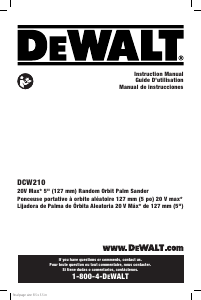
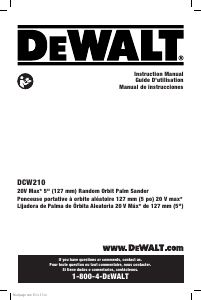
Manual de uso DeWalt DCW210P1 Lijadora excéntrica

¿Necesita un manual para su DeWalt DCW210P1 Lijadora excéntrica? A continuación puedes ver y descargar el manual en PDF gratis en español. Este producto actualmente tiene 4 preguntas frecuentes, 0 comentarios y tiene 0 votos. Si este no es el manual que desea, , contáctenos.

¿Su producto tiene algún defecto y el manual no ofrece ninguna solución? Vaya a Repair Café para solicitar un servicio de reparación gratuito.

Manual de uso

Loading…

ENGLISH
3
work to be performed. Use of the power tool for
operations different from those intended could result
in a hazardoussituation.
h ) Keep handles and grasping surfaces dry, clean
and free from oil and grease. Slippery handles and
grasping surfaces do not allow for safe handling and
control of the tool in unexpectedsituations.
5) Battery Tool Use and Care
a ) Recharge only with the charger specified by the
manufacturer. A charger that is suitable for one type
of battery pack may create a risk of fire when used
with another batterypack.
b ) Use power tools only with specifically designated
battery packs. Use of any other battery packs may
create a risk of injury andfire.
c ) When battery pack is not in use, keep it away
from other metal objects, like paper clips, coins,
keys, nails, screws, or other small metal objects,
that can make a connection from one terminal to
another. Shorting the battery terminals together may
cause burns or afire.
d ) Under abusive conditions, liquid may be ejected
from the battery; avoid contact. If contact
accidentally occurs, flush with water. If liquid
contacts eyes, additionally seek medical help.
Liquid ejected from the battery may cause irritation
orburns.
e ) Do not use a battery pack or tool that is
damaged or modified. Damaged or modified
batteries may exhibit unpredictable behavior resulting
in fire, explosion or risk ofinjury.
f ) Do not expose a battery pack or tool to fire
or excessive temperature. Exposure to fire or
temperature above 130 °C may causeexplosion.
g ) Follow all charging instructions and do not
charge the battery pack or tool outside the
temperature range specified in the instructions.
Charging improperly or at temperatures outside the
specified range may damage the battery and increase
the risk offire.
6) Service
a ) Have your power tool serviced by a qualified
repair person using only identical replacement
parts. This will ensure that the safety of the power
tool ismaintained.
b ) Never service damaged battery packs. Service
of battery packs should only be performed by the
manufacturer or authorized serviceproviders.
Additional Safety Instructions for Sanders
Always wear eye protection and a respirator
whensanding.
Sanding of lead-based paint is not recommended.
See Precautions to Take When Sanding Paint for
additional information before sandingpaint.
Do not operate the unit without the dust collection
bag or dust collectionsystem.
Clean your tool outperiodically.
Empty dust bag frequently, especially when sanding
resin coated surfaces such as polyurethane, varnish,
shellac, etc. Dispose of coated dust particles according
to the finish manufacturer’s guidelines, or place in a metal
can with a tight-fitting metal lid. Remove coated dust
particles from the premises daily. The accumulation of fine
sanding dust particles may self ignite and causefire.
Replace a worn or damaged belt when it causes
high tool rpm. High tool rpm caused by a worn out belt
may result in separation of sanding pad from the sander,
possibly causing personal injury. For instructions on
replacing the belt, see Replacing the Sanding Pad and
the Belt underMaintenance.
Additional Safety Information
WARNING: ALWAYS use safety glasses. Everyday
eyeglasses are NOT safety glasses. Also use face or
dust mask if cutting operation is dusty. ALWAYS WEAR
CERTIFIED SAFETYEQUIPMENT:
ANSI Z87.1 eye protection (CAN/CSA Z94.3),
ANSI S12.6 (S3.19) hearing protection,
NIOSH/OSHA/MSHA respiratoryprotection.
WARNING: Some dust created by power sanding,
sawing, grinding, drilling, and other construction
activities contains chemicals known to the State
of California to cause cancer, birth defects or
other reproductive harm. Some examples of these
chemicalsare:
lead from lead-based paints,
crystalline silica from bricks and cement and other
masonry products, and
arsenic and chromium from chemically-
treatedlumber.
Your risk from these exposures varies, depending on how
often you do this type of work. To reduce your exposure to
these chemicals: work in a well ventilated area, and work with
approved safety equipment, such as those dust masks that are
specially designed to filter out microscopicparticles.
Avoid prolonged contact with dust from power
sanding, sawing, grinding, drilling, and other
construction activities. Wear protective clothing and
wash exposed areas with soap and water. Allowing
dust to get into your mouth, eyes, or lay on the skin may
promote absorption of harmfulchemicals.
WARNING: Use of this tool can generate and/
or disperse dust, which may cause serious and
permanent respiratory or other injury. Always use
NIOSH/OSHA approved respiratory protection
appropriate for the dust exposure. Direct particles
away from face andbody.
WARNING: Always wear proper personal hearing
protection that conforms to ANSI S12.6 (S3.19)
during use. Under some conditions and duration
of use, noise from this product may contribute to
hearingloss.
Air vents often cover moving parts and should be
avoided. Loose clothes, jewelry or long hair can be
caught in movingparts.
Descargue el manual en Español (PDF, 5.3 MB)
(Piense en el medioambiente y solo imprima este manual si es de verdad necesario)

Loading…

Puntuación

Dé su opinión de la DeWalt DCW210P1 Lijadora excéntrica calificando el producto. ¿Quiere compartir su experiencia con este producto o hacer una pregunta? Deje un comentario en la parte inferior de la página.
¿Estás satisfecho con elDeWalt DCW210P1 Lijadora excéntrica?
No
Sea el primero en calificar este producto
0 votos

Únase a la conversación sobre este producto

Aquí puedes compartir lo que piensas sobre DeWalt DCW210P1 Lijadora excéntrica. Si tiene alguna pregunta, primero lea atentamente el manual. Puede solicitar un manual utilizando nuestro formulario de contacto.

Más sobre este manual

Entendemos que es bueno tener un manual en papel para tus DeWalt DCW210P1 Lijadora excéntrica. Siempre puedes descargar el manual desde nuestro sitio web e imprimirlo tú mismo. Si deseas tener un manual original te recomendamos contactar con DeWalt. Es posible que puedan proporcionar un manual original. ¿Estás buscando el manual de tu DeWalt DCW210P1 Lijadora excéntrica en otro idioma? Elija su idioma preferido en nuestra página de inicio y busque el número de modelo para ver si lo tenemos disponible.

Especificaciones

Marca DeWalt
Modelo DCW210P1
Categoría Lijadoras excéntricas
Tipo de archivo PDF
Tamaño del archivo 5.3 MB

Todos los manuales para DeWalt Lijadoras excéntricas
Más manuales de Lijadoras excéntricas

Preguntas frecuentes sobre DeWalt DCW210P1 Lijadora excéntrica

Nuestro equipo de atención al cliente busca información útil sobre los productos y responde a las preguntas frecuentes. Si encuentra inexactitudes en las preguntas frecuentes, indíquenoslo usando nuestro formulario de contacto.

¿Necesito usar una mascarilla contra el polvo cuando utilizo una lijadora? Verificado

Si. Durante el lijado se libera polvo que puede causar daños respiratorios. Algunas superficies también pueden liberar sustancias químicas como pintura o barniz durante el lijado. Éstas también son una buena razón para usar una mascarilla antipolvo.

Ha sido de gran ayuda (15) Leer más

¿Necesito usar protección auditiva cuando utilizo una lijadora? Verificado

Si deberías. Aunque la cantidad de ruido producido por una lijadora puede variar entre marcas y modelos, la exposición prolongada a ruidos fuertes puede causar daños auditivos permanentes. Por eso es una buena idea usar protección auditiva.

Ha sido de gran ayuda (9) Leer más

¿Necesito usar protección para los ojos cuando utilizo una lijadora? Verificado

Si. Pueden volar pequeñas partículas durante el lijado. Cuando estos golpean un ojo, pueden causar daño ocular permanente. Por eso siempre es necesario usar protección para los ojos.

Ha sido de gran ayuda (6) Leer más

¿Puedo guardar herramientas eléctricas en un cobertizo o garaje? Verificado

En general, las herramientas eléctricas se pueden guardar en un cobertizo o en un garaje, aunque a veces haga frío allí. Sin embargo, es mejor para la vida útil de la herramienta eléctrica guardarla en un lugar seco y sin grandes fluctuaciones de temperatura. En un cobertizo o garaje, las diferencias de temperatura pueden provocar la formación de condensación, lo que puede provocar oxidación. Además, las herramientas que funcionan con baterías duran menos y no se cargan tan bien a temperaturas muy bajas. Para estar seguro de cómo debe almacenarse su herramienta eléctrica, lea siempre detenidamente el manual del usuario.

Ha sido de gran ayuda (6) Leer más
Manual de uso DeWalt DCW210P1 Lijadora excéntrica

Productos relacionados

Categorias relacionadas

×
Download