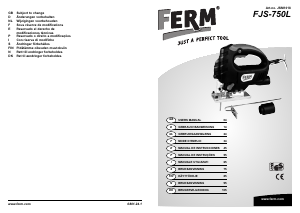
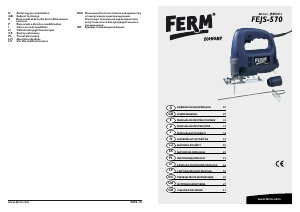
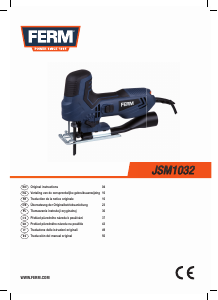
Manual de uso FERM JSM1001 Sierra de calar

¿Necesita un manual para su FERM JSM1001 Sierra de calar? A continuación puedes ver y descargar el manual en PDF gratis en español. Este producto actualmente tiene 4 preguntas frecuentes, 0 comentarios y tiene 0 votos. Si este no es el manual que desea, , contáctenos.

¿Su producto tiene algún defecto y el manual no ofrece ninguna solución? Vaya a Repair Café para solicitar un servicio de reparación gratuito.

Manual de uso

Loading…

Ferm 69
3. Always switch the jigsaw on in idle, i.e. switch the saw
on before bringing it into contact with the workpiece.
4. When sawing the wood watch out for knots, nails,
cracks and/or dirt deposits.
These can cause the saw to jam dangerously. Also
watch out for this with waste wood. This often requi-
res less careful sawing, so there is a danger that you
may not be quite so careful about watching out for
irregularities in the wood.
5. Do not saw workpieces that are thicker than the
length of the saw.
6. Do not touch metal parts of the jigsaw when sawing in
walls or floors in which there could be electricity cab-
les. Hold the jigsaw tightly with both hands on the
plastic grip so that you do not touch parts that could
become live if you accidentally saw through an elec-
tricity cable.
7. When you have finished sawing, switch off the appli-
ance first and wait until the saw comes to a standstill
before removing it from the workpiece.
8. Do not use long extension cables.
9. Keep the plastic guard in place while the saw is in use.
TURN THE APPLIANCE OFF IMMEDIATELY
IN THE EVENT OF:
1. a faulty mains plug, mains flex or flex damage;
2. a faulty switch;
3. sparking in the carbon brushes or ring fire in the com-
mutator;
4. smoke or smell from scorched insulation.
ASSEMBLY INSTRUCTIONS
APPLICATIONS
The jigsaw can be used to cut workpieces of various
materials (wood, aluminium, plastic, metal etc.) precisely
to size and in any desired shape. The maximum thickness
of the workpiece is 70 mm (for wood).
SELECTING THE SAW
Fig. 2 - Types of saw blades
The jigsaw is supplied with four saws, each with different
teeth. The profile and the teeth vary according to the
material that you want to saw. A fine tooth will give you a
smooth and precise saw cut. Use a narrow profile if you
want to saw curves or if you are going to saw figures.
To select the right saw, proceed as follows:
1. First of all try a saw with coarse teeth.
2. If you don't get a smooth and precise saw cut, try a
saw with a finer tooth.
3. For plastic, aluminium and steel always use a saw with
a very fine tooth.
In general you will work faster but less precisely with a
coarse tooth than with a fine tooth.
For an optimum result always make sure the saw is sharp.
The jigsaw is suitable for all commercially available saw
blades (Fig. 2).
ASSEMBLING SAW
Fig. 3 - Assembling saw
Before assembling the saw check that the mains
plug has been removed from the socket.
To assemble the saw, proceed as follows (Fig. 3):
1. Loosen the two socket head screws (A) with the
Allen key supplied.
2. Place the saw (C) in the saw buckle (B).
Make sure that the teeth point upwards and forward.
The smooth side of the saw must rest against the
wheel.
3. Push the saw as far into the buckle as possible.
4. Secure the saw by tightening the two socket head
screws (A) again.
Make sure that the socket head screws are tightened
evenly so that the saw blade sits correctly in the saw
buckle. A crooked blade can result in an unsatisfac-
tory cut.
5. Push the guard down.
ADJUSTING THE BOTTOM PLATE
Fig. 4 - Adjusting angle of bottom plate
Adjust the angle of the bottom plate (A) as follows (Fig.
4):
1. Loosen the socket head screws (B) with the Allen key
supplied.
2. Pull the bottom plate back slightly to unlock it.
3. Turn the bottom plate to the right or left in the des-
ired sawing angle.
You can read this on the protractor (C). The maxi-
mum sawing angle is 45º.
4. Push the bottom plate forward again to interlock it.
5. Tighten the socket head screws (B) again.
4 Ferm
Descargue el manual en Español (PDF, 1.46 MB)
(Piense en el medioambiente y solo imprima este manual si es de verdad necesario)

Loading…

Puntuación

Dé su opinión de la FERM JSM1001 Sierra de calar calificando el producto. ¿Quiere compartir su experiencia con este producto o hacer una pregunta? Deje un comentario en la parte inferior de la página.
¿Estás satisfecho con elFERM JSM1001 Sierra de calar?
No
Sea el primero en calificar este producto
0 votos

Únase a la conversación sobre este producto

Aquí puedes compartir lo que piensas sobre FERM JSM1001 Sierra de calar. Si tiene alguna pregunta, primero lea atentamente el manual. Puede solicitar un manual utilizando nuestro formulario de contacto.

Más sobre este manual

Entendemos que es bueno tener un manual en papel para tus FERM JSM1001 Sierra de calar. Siempre puedes descargar el manual desde nuestro sitio web e imprimirlo tú mismo. Si deseas tener un manual original te recomendamos contactar con FERM. Es posible que puedan proporcionar un manual original. ¿Estás buscando el manual de tu FERM JSM1001 Sierra de calar en otro idioma? Elija su idioma preferido en nuestra página de inicio y busque el número de modelo para ver si lo tenemos disponible.

Especificaciones

Marca FERM
Modelo JSM1001
Categoría Sierras de calar
Tipo de archivo PDF
Tamaño del archivo 1.46 MB

Todos los manuales para FERM Sierras de calar
Más manuales de Sierras de calar

Preguntas frecuentes sobre FERM JSM1001 Sierra de calar

Nuestro equipo de atención al cliente busca información útil sobre los productos y responde a las preguntas frecuentes. Si encuentra inexactitudes en las preguntas frecuentes, indíquenoslo usando nuestro formulario de contacto.

¿En qué materiales puedo usar la caladora? Verificado

Debido a sus hojas intercambiables, la caladora se puede usar con casi todos los materiales. La caladora se usa sobre todo para cortar curvas y esquinas.

Ha sido de gran ayuda (482) Leer más

¿Necesito usar protección para los ojos cuando utilizo una sierra de vaivén? Verificado

Si. Pueden volar pequeñas partículas durante el aserrado. Cuando estos golpean un ojo, pueden causar daño ocular permanente. Por eso siempre es necesario usar protección para los ojos.

Ha sido de gran ayuda (246) Leer más

¿Puedo guardar herramientas eléctricas en un cobertizo o garaje? Verificado

En general, las herramientas eléctricas se pueden guardar en un cobertizo o en un garaje, aunque a veces haga frío allí. Sin embargo, para prolongar la vida útil de la herramienta eléctrica, es mejor guardarla en un lugar seco y sin grandes fluctuaciones de temperatura. En un cobertizo o garaje, las diferencias de temperatura pueden provocar la formación de condensación, lo que puede provocar oxidación. Además, las herramientas que funcionan con baterías duran menos y no se cargan tan bien a temperaturas muy bajas. Para estar seguro de cómo debe almacenarse su herramienta eléctrica, lea siempre detenidamente el manual del usuario.

Ha sido de gran ayuda (89) Leer más

¿Necesito usar protección auditiva cuando uso una sierra de calar? Verificado

Si deberías. Aunque la cantidad de ruido producido por una sierra de calar puede variar según las marcas y modelos, la exposición prolongada a ruidos fuertes puede causar daños auditivos permanentes. Por eso es una buena idea usar protección auditiva.

Ha sido de gran ayuda (80) Leer más
Manual de uso FERM JSM1001 Sierra de calar

Productos relacionados

Categorias relacionadas

×
Download