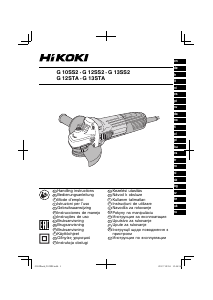
Manual de uso Hikoki G 10SS2 Amoladora angular

¿Necesita un manual para su Hikoki G 10SS2 Amoladora angular? A continuación puedes ver y descargar el manual en PDF gratis en español. Este producto actualmente tiene 4 preguntas frecuentes, 0 comentarios y tiene 0 votos. Si este no es el manual que desea, , contáctenos.

¿Su producto tiene algún defecto y el manual no ofrece ninguna solución? Vaya a Repair Café para solicitar un servicio de reparación gratuito.

Manual de uso

Loading…

3
English
SAFETY WARNINGS COMMON FOR
GRINDING OR ABRASIVE CUTTING-
OFF OPERATIONS
a) This power tool is intended to function as a
grinder or cut-o tool. Read all safety warnings,
instructions, illustrations and speci cations
provided with this power tool.
Failure to follow all instructions listed below may result in
electric shock, re and/or serious injury.
b) Operations such as sanding, wire brushing or
polishing are not recommended to be performed
with this power tool.
Operations for which the power tool was not designed
may create a hazard and cause personal injury.
c)
Do not use accessories which are not speci cally
designed and recommended by the tool manufacturer.
Just because the accessory can be attached to your
power tool, it does not assure safe operation.
d)
The rated speed of the accessory must be at least equal
to the maximum speed marked on the power tool.
Accessories running faster than their rated speed can
break and y apart.
e) The outside diameter and the thickness of your
accessory must be within the capacity rating of
your power tool.
Incorrectly sized accessories cannot be adequately
guarded or controlled.
f) Threaded mounting of accessories must match the
grinder spindle thread. For accessories mounted
by anges, the arbour hole of accessory must t
the locating diameter of the ange.
Accessories that do not match the mounting hardware of
the power tool will run out of balance, vibrate excessively
and may cause loss of control.
g) Do not use a damaged accessory. Before each use
inspect the accessory such as abrasive wheels for
chips and cracks, backing pad for cracks, tear or
excess wear, wire brush for loose or cracked wires.
If power tool or accessory is dropped, inspect for
damage or install an undamaged accessory. After
inspecting and installing an accessory, position
yourself and bystanders away from the plane of
the rotating accessory and run the power tool at
maximum no-load speed for one minute.
Damaged accessories will normally break apart during
this test time.
h)
Wear personal protective equipment. Depending on
application, use face shield, safety goggles or safety
glasses. As appropriate, wear dust mask, hearing
protectors, gloves and workshop apron capable of
stopping small abrasive or workpiece fragments.
The eye protection must be capable of stopping ying
debris generated by various operations. The dust mask
or respirator must be capable of ltrating particles
generated by your operation. Prolonged exposure to
high intensity noise may cause hearing loss.
i) Keep bystanders a safe distance away from work
area. Anyone entering the work area must wear
personal protective equipment.
Fragments of workpiece or of a broken accessory may
y away and cause injury beyond immediate area of
operation.
j)
Hold the power tool by insulated gripping surfaces
only, when performing an operation where the cutting
accessory may contact hidden wiring or its own cord.
Cutting accessory contacting a “live” wire may make
exposed metal parts of the power tool “live” and could
give the operator an electric shock.
k) Position the cord clear of the spinning accessory.
If you lose control, the cord may be cut or snagged and your
hand or arm may be pulled into the spinning accessory.
l) Never lay the power tool down until the accessory
has come to a complete stop.
The spinning accessory may grab the surface and pull
the power tool out of your control.
m)
Do not run the power tool while carrying it at your side.
Accidental contact with the spinning accessory could
snag your clothing, pulling the accessory into your body.
n) Regularly clean the power tool’s air vents.
The motor’s fan will draw the dust inside the housing and
excessive accumulation of powdered metal may cause
electrical hazards.
o)
Do not operate the power tool near ammable materials.
Sparks could ignite these materials.
p) Do not use accessories that require liquid coolants.
Using water or other liquid coolants may result in
electrocution or shock.
KICKBACK AND RELATED
WARNINGS
Kickback is a sudden reaction to a pinched or snagged
rotating wheel, backing pad, brush or any other accessory.
Pinching or snagging causes rapid stalling of the rotating
accessory which in turn causes the uncontrolled power tool
to be forced in the direction opposite of the accessory’s
rotation at the point of the binding.
For example, if an abrasive wheel is snagged or pinched by
the workpiece, the edge of the wheel that is entering into the
pinch point can dig into the surface of the material causing
the wheel to climb out or kick out. The wheel may either jump
toward or away from the operator, depending on direction of
the wheel’s movement at the point of pinching.
Abrasive wheels may also break under these conditions.
Kickback is the result of power tool misuse and/or incorrect
operating procedures or conditions and can be avoided by
taking proper precautions as given below.
a)
Maintain a rm grip on the power tool and position your
body and arm to allow you to resist kickback forces.
Always use auxiliary handle, if provided, for maximum
control over kickback or torque reaction during start-up.
The operator can control torque reactions or kickback
forces, if proper precautions are taken.
b) Never place your hand near the rotating accessory.
Accessory may kickback over your hand.
c) Do not position your body in the area where power
tool will move if kickback occurs.
Kickback will propel the tool in direction opposite to the
wheel’s movement at the point of snagging.
d) Use special care when working corners, sharp edges
etc. Avoid bouncing and snagging the accessory.
Corners, sharp edges or bouncing have a tendency to
snag the rotating accessory and cause loss of control or
kickback.
e) Do not attach a saw chain woodcarving blade or
toothed saw blade.
Such blades create frequent kickback and loss of control.
SAFETY WARNINGS SPECIFIC FOR
GRINDING AND ABRASIVE CUTTING-
OFF OPERATIONS
a) Use only wheel types that are recommended for
your power tool and the speci c guard designed
for the selected wheel.
Wheels for which the power tool was not designed
cannot be adequately guarded and are unsafe.
b) The grinding surface of centre depressed wheels
must be mounted below the plane of the guard lip.
An improperly mounted wheel that projects through the
plane of the guard lip cannot be adequately protected.
0000Book̲G10SS2.indb30000Book̲G10SS2.indb3 2017/12/0413:44:572017/12/0413:44:57
Descargue el manual en Español (PDF, 11.06 MB)
(Piense en el medioambiente y solo imprima este manual si es de verdad necesario)

Loading…

Puntuación

Dé su opinión de la Hikoki G 10SS2 Amoladora angular calificando el producto. ¿Quiere compartir su experiencia con este producto o hacer una pregunta? Deje un comentario en la parte inferior de la página.
¿Estás satisfecho con elHikoki G 10SS2 Amoladora angular?
No
Sea el primero en calificar este producto
0 votos

Únase a la conversación sobre este producto

Aquí puedes compartir lo que piensas sobre Hikoki G 10SS2 Amoladora angular. Si tiene alguna pregunta, primero lea atentamente el manual. Puede solicitar un manual utilizando nuestro formulario de contacto.

Más sobre este manual

Entendemos que es bueno tener un manual en papel para tus Hikoki G 10SS2 Amoladora angular. Siempre puedes descargar el manual desde nuestro sitio web e imprimirlo tú mismo. Si deseas tener un manual original te recomendamos contactar con Hikoki. Es posible que puedan proporcionar un manual original. ¿Estás buscando el manual de tu Hikoki G 10SS2 Amoladora angular en otro idioma? Elija su idioma preferido en nuestra página de inicio y busque el número de modelo para ver si lo tenemos disponible.

Especificaciones

Marca Hikoki
Modelo G 10SS2
Categoría Amoladoras angulares
Tipo de archivo PDF
Tamaño del archivo 11.06 MB

Todos los manuales para Hikoki Amoladoras angulares
Más manuales de Amoladoras angulares

Preguntas frecuentes sobre Hikoki G 10SS2 Amoladora angular

Nuestro equipo de atención al cliente busca información útil sobre los productos y responde a las preguntas frecuentes. Si encuentra inexactitudes en las preguntas frecuentes, indíquenoslo usando nuestro formulario de contacto.

¿En qué material puedo usar mi amoladora angular? Verificado

Las amoladoras angulares son más adecuadas para su uso en metal o piedra. Las máquinas generan mucho calor y, por lo tanto, son menos adecuadas para su uso en madera o plástico.

Ha sido de gran ayuda (82) Leer más

¿Puedo guardar herramientas eléctricas en un cobertizo o garaje? Verificado

En general, las herramientas eléctricas se pueden guardar en un cobertizo o en un garaje, aunque a veces haga frío allí. Sin embargo, para prolongar la vida útil de la herramienta eléctrica, es mejor guardarla en un lugar seco y sin grandes fluctuaciones de temperatura. En un cobertizo o garaje, las diferencias de temperatura pueden provocar la formación de condensación, lo que puede provocar oxidación. Además, las herramientas que funcionan con baterías duran menos y no se cargan tan bien a temperaturas muy bajas. Para estar seguro de cómo debe almacenarse su herramienta eléctrica, lea siempre detenidamente el manual del usuario.

Ha sido de gran ayuda (59) Leer más

¿Necesito usar protección para los oídos cuando utilizo una amoladora angular? Verificado

Si deberías. Aunque la cantidad de ruido producido por una amoladora angular puede variar entre marcas y modelos, la exposición prolongada a ruidos fuertes puede causar daños auditivos permanentes. Por eso es una buena idea usar protección auditiva.

Ha sido de gran ayuda (28) Leer más

¿Necesito usar protección para los ojos cuando utilizo una amoladora angular? Verificado

Si. Las partículas pequeñas pueden volar durante la molienda. Cuando estos golpean un ojo, pueden causar daño ocular permanente. Por eso siempre es necesario usar protección para los ojos.

Ha sido de gran ayuda (24) Leer más
Manual de uso Hikoki G 10SS2 Amoladora angular

Productos relacionados

Categorias relacionadas

×
Download