4
5
The grounding prong in the plug is connected
through the green wire inside the cord to the
grounding system in the tool. The green wire in the
cord must be the only wire connected to the tool's
grounding system and must never be attached to
an electrically “live” terminal.
Your tool must be plugged into
an appropriate outlet, properly
installed and grounded in accord-
ance with all codes and ordinanc-
es. The plug and outlet should look
like those in Figure A.
Double Insulated Tools:
Tools with Two Prong Plugs
Tools marked “Double Insulated” do not require
grounding. They have a special double insula-
tion system which satisfi es OSHA requirements
and complies with the applicable standards of
Underwriters Laboratories, Inc.,
the Canadian Standard Asso-
ciation and the National Elec-
trical Code. Double Insulated
tools may be used in either of
the 120 volt outlets shown in
Figures B and C.
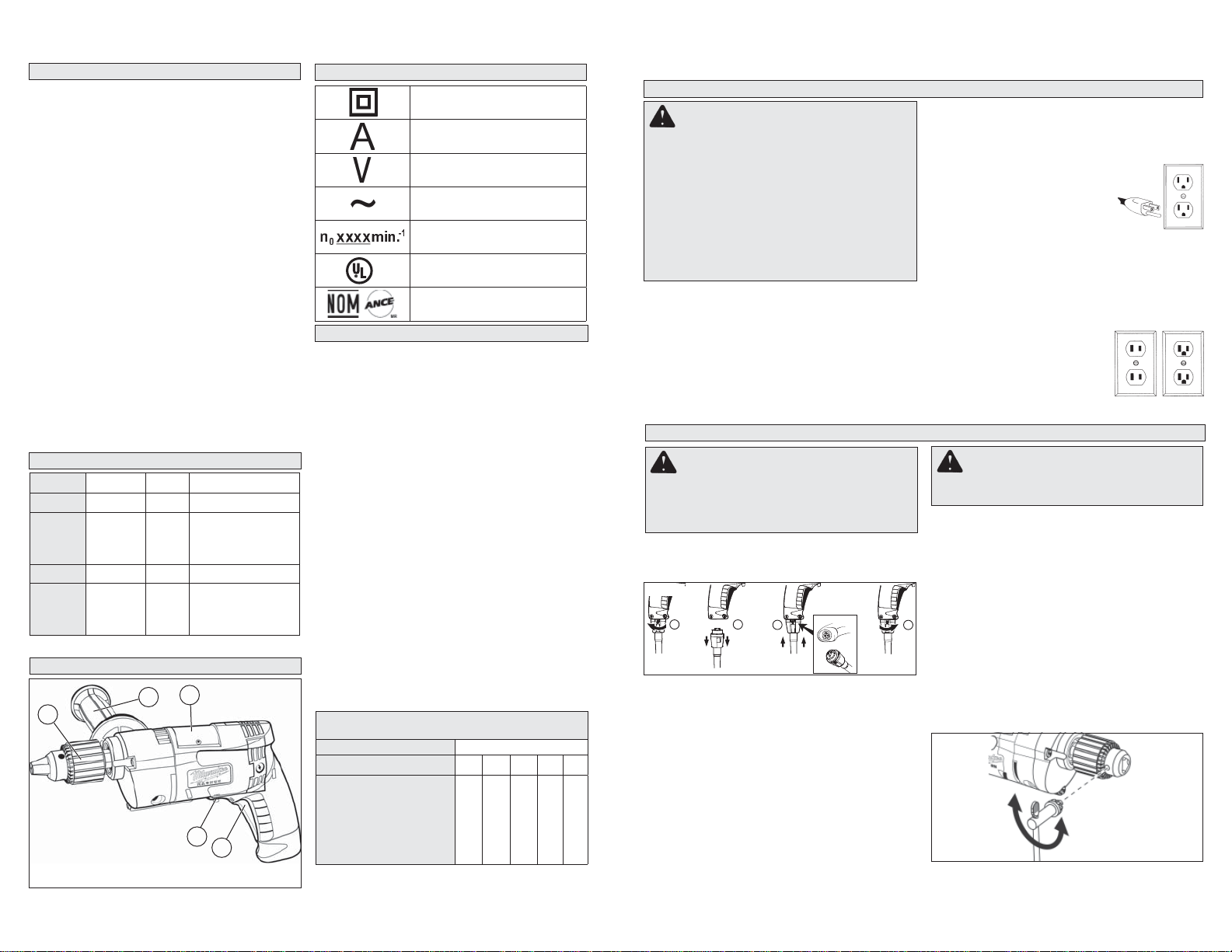
SPECIFICATIONS
Cat. No. Volts AC Amps No Load RPM
0233-20 120 5.5 0-2800
0234-6 120 5.5 without RAD 0-950
RAD low 0-630
Rad high 0-1425
0235-21 120 5.5 0-950
0244-1 120 5.5 without RAD 0-700
RAD low 0-465
RAD high 0-1050
Double Insulated
Amps
Volts
Alternating Current Only
No Load Revolutions
per Minute (RPM)
C
US
Underwriters Laboratories, Inc.
United States and Canada
Mexican Approvals Marking
SYMBOLOGY
FUNCTIONAL DESCRIPTION
4
1. Chuck
2. Side handle
3. Nameplate
4. Trigger
5. Forward/Reverse switch
2
1
3
5
Right Angle Drive Unit Cat. No. 48-06-2871
Grounded tools require a three wire extension
cord. Double insulated tools can use either a two
or three wire extension cord. As the distance from
the supply outlet increases, you must use a heavier
gauge extension cord. Using extension cords with
inadequately sized wire causes a serious drop in
voltage, resulting in loss of power and possible tool
damage. Refer to the table shown to determine the
required minimum wire size.
The smaller the gauge number of the wire, the
greater the capacity of the cord. For example, a 14
gauge cord can carry a higher current than a 16
gauge cord. When using more than one extension
cord to make up the total length, be sure each cord
contains at least the minimum wire size required.
If you are using one extension cord for more than
one tool, add the nameplate amperes and use the
sum to determine the required minimum wire size.
Guidelines for Using Extension Cords
• If you are using an extension cord outdoors, be
sure it is marked with the suffi x “W-A” (“W” in Cana-
da) to indicate that it is acceptable for outdoor use.
• Be sure your extension cord is properly wired
and in good electrical condition. Always replace a
damaged extension cord or have it repaired by a
qualifi ed person before using it.
• Protect your extension cords from sharp objects,
excessive heat and damp or wet areas.
* Based on limiting the line voltage drop to fi ve volts at
150% of the rated amperes.
EXTENSION CORDS
Recommended Minimum Wire Gauge
For Extension Cords*
Extension Cord Length
Nameplate Amperes
25' 50' 75' 100' 150'
0 - 2.0
2.1 - 3.4
3.5 - 5.0
5.1 - 7.0
7.1 - 12.0
12.1 - 16.0
16.1 - 20.0
18
18
18
18
16
14
12
18
18
18
16
14
12
10
18
18
16
14
12
10
18
16
14
12
10
16
14
12
12
Fig. B
Fig. C
Fig. A
GROUNDING
WARNING Improperly connecting the
grounding wire can result in the risk of elec-
tric shock. Check with a qualifi ed electrician
if you are in doubt as to whether the outlet is
properly grounded. Do not modify the plug
provided with the tool. Never remove the
grounding prong from the plug. Do not use
the tool if the cord or plug is damaged. If
damaged, have it repaired by a MILWAUKEE
service facility before use. If the plug will not
fi t the outlet, have a proper outlet installed by
a qualifi ed electrician.
Grounded Tools: Tools with Three Prong Plugs
Tools marked “Grounding Required” have a three
wire cord and three prong grounding plug. The
plug must be connected to a properly grounded
outlet (See Figure A). If the tool should electrically
malfunction or break down, grounding provides a
low resistance path to carry electricity away from
the user, reducing the risk of electric shock.
READ AND SAVE ALL INSTRUCTIONS FOR FUTURE USE.
ASSEMBLY
WARNING To reduce the risk of injury,
always unplug tool before changing or re-
moving accessories. Only use accessories
specifi cally recommended for this tool. Others
may be hazardous.
Removing and Replacing Quik-Lok
®
Cords
MILWAUKEE's exclusive Quik-Lok
®
Cords provide
instant fi eld replacement or substitution.
1. To remove the Quik-Lok
®
Cord, turn the cord nut
1/4 turn to the left and pull it out.
2. To replace the Quik-Lok
®
Cord, align the connec-
tor keyways and push the connector in as far as it
will go. Turn the cord nut 1/4 turn to the right to lock.
Installing Side Handle
MILWAUKEE Magnum Drills are supplied with a
side handle that can be installed on either side of
the tool for right or left handed use. To install the
side handle, thread it into the socket on the desired
side of the tool and tighten it securely. Always use
the side handle for best control.
Installing Bits into Keyed Chucks
(Cat. No. 0234-6, 0244-1)
Always unplug the tool before installing or remov-
ing bits.
1. Open the chuck jaws wide enough to insert the bit.
Be sure the bit shank and chuck jaws are clean.
Dirt particles may prevent the bit from lining up
properly.
2. When using drill bits, insert the bit into the chuck.
Center the bit in the chuck jaws and lift it about
1/16" off of the bottom. Tighten the chuck jaws by
hand to align the bit.
When using screwdriver bits, insert the bit far
enough for the chuck jaws to grip the bit shank.
Tighten the chuck jaws by hand to align the bit.
3. Place the chuck key in each of the three holes in
the chuck, turning it clockwise as shown. Tighten
securely.
WARNING To prevent personal injury,
always remove the chuck key from the chuck
after each use.
1 2
4
3
Fig. 1
Tighten
Loosen
Fig. 2
4. To remove the bit, insert the chuck key into one of
the holes in the chuck and turn it counterclockwise.
SPECIFIC SAFETY RULES
• Use auxiliary handle(s), if supplied with the
tool. Loss of control can cause personal injury.
• Hold power tool by insulated gripping surfaces,
when performing an operation where the cutting
accessory may contact hidden wiring or its
own cord. Cutting accessory contacting a “live”
wire may make exposed metal parts of the power
tool “live” and could give the operator an electric
shock.
• Maintain labels and nameplates. These carry
important information. If unreadable or missing,
contact a MILWAUKEE service facility for a free
replacement.
• WARNING Some dust created by power sanding,
sawing, grinding, drilling, and other construction
activities contains chemicals known to cause
cancer, birth defects or other reproductive harm.
Some examples of these chemicals are:
• lead from lead-based paint
• crystalline silica from bricks and cement and
other masonry products, and
• arsenic and chromium from chemically-treated
lumber.
Your risk from these exposures varies, depending
on how often you do this type of work. To reduce
your exposure to these chemicals: work in a well
ventilated area, and work with approved safety
equipment, such as those dust masks that are spe-
cially designed to fi lter out microscopic particles.





Únase a la conversación sobre este producto
Aquí puedes compartir lo que piensas sobre Milwaukee 0244-1 Taladradora de percusión. Si tiene alguna pregunta, primero lea atentamente el manual. Puede solicitar un manual utilizando nuestro formulario de contacto.