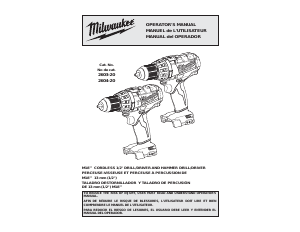
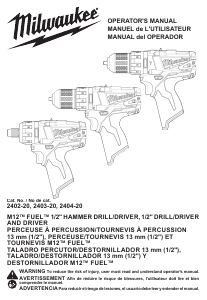
Manual de uso Milwaukee 2403-20 Atornillador taladrador

¿Necesita un manual para su Milwaukee 2403-20 Atornillador taladrador? A continuación puedes ver y descargar el manual en PDF gratis en español. Este producto actualmente tiene 3 preguntas frecuentes, 0 comentarios y tiene 0 votos. Si este no es el manual que desea, , contáctenos.

¿Su producto tiene algún defecto y el manual no ofrece ninguna solución? Vaya a Repair Café para solicitar un servicio de reparación gratuito.

Manual de uso

Loading…

3
When battery pack is not in use, keep it away
from other metal objects, like paper clips, coins,
keys, nails, screws or other small metal objects,
that can make a connection from one terminal to
another. Shorting the battery terminals together may
cause burns or a re.
Under abusive conditions, liquid may be ejected
from the battery; avoid contact. If contact ac-
cidentally occurs, ush with water. If liquid con-
tacts eyes, additionally seek medical help. Liquid
ejected from the battery may cause irritation or burns.
Do not use a battery pack or tool that is dam-
aged or modied. Damaged or modied batteries
may exhibit unpredictable behavior resulting in re,
explosion or risk of injury.
Do not expose a battery pack or tool to re or
excessive temperature. Exposure to re or tem-
perature above 265°F (130°C) may cause explosion.
Follow all charging instructions and do not
charge the battery pack or tool outside the
temperature range specied in the instructions.
Charging improperly or at temperatures outside the
specied range may damage the battery and increase
the risk of re.
SERVICE
Have your power tool serviced by a qualied
repair person using only identical replacement
parts. This will ensure that the safety of the power
tool is maintained.
Never service damaged battery packs. Service
of battery packs should only be performed by the
manufacturer or authorized service providers.
SPECIFIC SAFETY RULES FOR
DRILL/DRIVER
Safey instructions for all operations
Wear ear protectors when impact drilling. Expo-
sure to noise can cause hearing loss.
Hold power tool by insulated gripping surfaces,
when performing an operation where the cutting
accessory or fasteners may contact hidden wiring.
Cutting accessory or fasteners contacting a “live”
wire may make exposed metal parts of the power tool
“live” and could give the operator an electric shock.
Safety instructions when using long drill bits
•Never operate at higher speed than the maximum
speed rating of the drill bit. At higher speeds, the
bit is likely to bend if allowed to rotate freely without
contacting the workpiece, resulting in personal injury.
Always start drilling at low speed and with the bit
tip in contact with the workpiece. At higher speeds,
the bit is likely to bend if allowed to rotate freely without
contacting the workpiece, resulting in personal injury.
Apply pressure only in direct line with the bit
and do not apply excessive pressure. Bits can
bend causing breakage or loss of control, resulting
in personal injury.
SPECIFIC SAFETY RULES FOR
SCREWDRIVERS
Hold power tool by insulated gripping surfaces,
when performing an operation where the fastener
may contact hidden wiring. Fasteners contacting
a “live” wire may make exposed metal parts of the
power tool “live” and could give the operator an
electric shock.
WARNING
To reduce the risk of injury, when
working in dusty situations, wear
appropriate respiratory protection or use an
OSHA compliant dust extraction solution.
Always use common sense and be cautious when
using tools. It is not possible to anticipate every
situation that could result in a dangerous outcome.
Do not use this tool if you do not understand these
operating instructions or you feel the work is beyond
your capability; contact Milwaukee Tool or a trained
professional for additional information or training.
Maintain labels and nameplates. These carry im-
portant information. If unreadable or missing, contact
a MILWAUKEE service facility for a free replacement.
WARNING
Some dust created by power sanding,
sawing, grinding, drilling, and other
construction activities contains chemicals known to
cause cancer, birth defects or other reproductive
harm. Some examples of these chemicals are:
lead from lead-based paint
crystalline silica from bricks and cement and other
masonry products, and
arsenic and chromium from chemically-treated lum-
ber.
Your risk from these exposures varies, depending on
how often you do this type of work. To reduce your
exposure to these chemicals: work in a well ventilated
area, and work with approved safety equipment, such
as those dust masks that are specially designed to
lter out microscopic particles.
SPECIFICATIONS
Volts .............................................................. 12 DC
Battery Type .................................................M12™
Charger Type ................................................M12™
Recommended Ambient
Operating Temperature ......................0°F to 125°F
Cat. No. ..................................................... 2402-20
No Load RPM ........................LO 0-450 HI 0-1700
Capacities
Steel ........................................................1/4" Hex
Wood
Flat Bit ..................................................... 1-1/8"
Auger Bit ........................................................ 1"
Screws (dia.)............................................... 3/8"
Battery Type .................................................M12™
Charger Type ................................................M12™
Cat. No. ..................................................... 2403-20
No Load RPM ........................LO 0-450 HI 0-1700
Capacities
Steel ............................................................... 1/2"
Wood
Flat Bit ..................................................... 1-1/8"
Auger Bit ........................................................ 1"
Hole Saw .................................................1-3/4"
Screws (dia.)............................................... 3/8"
Cat. No. ..................................................... 2404-20
No Load RPM ........................LO 0-450 HI 0-1700
No Load IPM............................ LO 6750 HI 25,500
Capacities
Steel ............................................................... 1/2"
Wood
Flat Bit ..................................................... 1-1/8"
Auger Bit ........................................................ 1"
Hole Saw .................................................1-3/4"
Screws (dia.)............................................... 3/8"
Masonary .................................................... 3/8"
Descargue el manual en Español (PDF, 3.69 MB)
(Piense en el medioambiente y solo imprima este manual si es de verdad necesario)

Loading…

Puntuación

Dé su opinión de la Milwaukee 2403-20 Atornillador taladrador calificando el producto. ¿Quiere compartir su experiencia con este producto o hacer una pregunta? Deje un comentario en la parte inferior de la página.
¿Estás satisfecho con elMilwaukee 2403-20 Atornillador taladrador?
No
Sea el primero en calificar este producto
0 votos

Únase a la conversación sobre este producto

Aquí puedes compartir lo que piensas sobre Milwaukee 2403-20 Atornillador taladrador. Si tiene alguna pregunta, primero lea atentamente el manual. Puede solicitar un manual utilizando nuestro formulario de contacto.

Más sobre este manual

Entendemos que es bueno tener un manual en papel para tus Milwaukee 2403-20 Atornillador taladrador. Siempre puedes descargar el manual desde nuestro sitio web e imprimirlo tú mismo. Si deseas tener un manual original te recomendamos contactar con Milwaukee. Es posible que puedan proporcionar un manual original. ¿Estás buscando el manual de tu Milwaukee 2403-20 Atornillador taladrador en otro idioma? Elija su idioma preferido en nuestra página de inicio y busque el número de modelo para ver si lo tenemos disponible.

Especificaciones

Marca Milwaukee
Modelo 2403-20
Categoría Atornilladores taladrador
Tipo de archivo PDF
Tamaño del archivo 3.69 MB

Todos los manuales para Milwaukee Atornilladores taladrador
Más manuales de Atornilladores taladrador

Preguntas frecuentes sobre Milwaukee 2403-20 Atornillador taladrador

Nuestro equipo de atención al cliente busca información útil sobre los productos y responde a las preguntas frecuentes. Si encuentra inexactitudes en las preguntas frecuentes, indíquenoslo usando nuestro formulario de contacto.

Sigo quitando la cabeza del tornillo cuando uso el destornillador. ¿Porqué es eso? Verificado

La mayoría de los destornilladores pueden configurarse para atornillar más fuerte o más suave. Si la cabeza sigue siendo despojada, el taladro-destornillador probablemente debería colocarse en una configuración diferente. Cuando se trata de un dispositivo inalámbrico, asegúrese siempre de que la batería esté cargada para obtener un resultado óptimo.

Ha sido de gran ayuda (97) Leer más

¿Necesito usar protección auditiva cuando utilizo un taladro? Verificado

Si deberías. Aunque la cantidad de ruido producido por un taladro puede variar entre marcas y modelos, la exposición prolongada a ruidos fuertes puede causar daños auditivos permanentes. Por eso es una buena idea usar protección auditiva.

Ha sido de gran ayuda (37) Leer más

¿Puedo guardar herramientas eléctricas en un cobertizo o garaje? Verificado

En general, las herramientas eléctricas se pueden guardar en un cobertizo o en un garaje, aunque a veces haga frío allí. Sin embargo, para prolongar la vida útil de la herramienta eléctrica, es mejor guardarla en un lugar seco y sin grandes fluctuaciones de temperatura. En un cobertizo o garaje, las diferencias de temperatura pueden provocar la formación de condensación, lo que puede provocar oxidación. Además, las herramientas que funcionan con baterías duran menos y no se cargan tan bien a temperaturas muy bajas. Para estar seguro de cómo debe almacenarse su herramienta eléctrica, lea siempre detenidamente el manual del usuario.

Ha sido de gran ayuda (29) Leer más
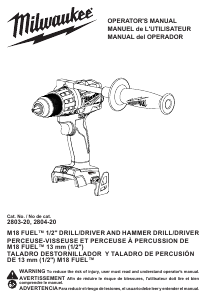
Manual de uso Milwaukee 2403-20 Atornillador taladrador

Productos relacionados

Categorias relacionadas

×
Download