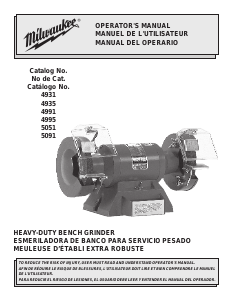
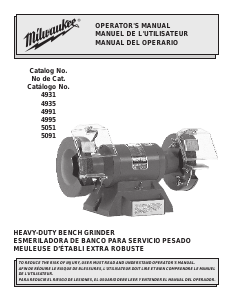
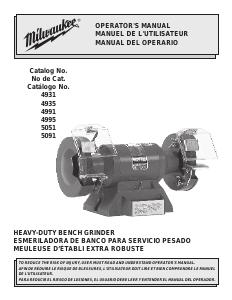
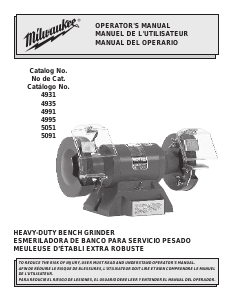
Manual de uso Milwaukee 4995 Amoladora de banco

¿Necesita un manual para su Milwaukee 4995 Amoladora de banco? A continuación puedes ver y descargar el manual en PDF gratis en español. Este producto actualmente tiene 1 pregunta frecuente, 0 comentarios y tiene 0 votos. Si este no es el manual que desea, , contáctenos.

¿Su producto tiene algún defecto y el manual no ofrece ninguna solución? Vaya a Repair Café para solicitar un servicio de reparación gratuito.

Manual de uso

Loading…
Page 6
GROUNDING
Grounded tools require a three wire extension cord. Double insulated
tools can use either a two or three wire extension cord. As the distance
from the supply outlet increases, you must use a heavier gauge exten-
sion cord. Using extension cords with inadequately sized wire causes
a serious drop in voltage, resulting in loss of power and possible tool
damage. Refer to the table at right to determine the required minimum
wire size.
The smaller the gauge number of the wire, the greater the capacity of the
cord. For example, a 14 gauge cord can carry a higher current than a 16
gauge cord. When using more than one extension cord to make up the
total length, be sure each cord contains at least the minimum wire size
required. If you are using one extension cord for more than one tool, add
the nameplate amperes and use the sum to determine the required mini-
mum wire size.
Guidelines for Using Extension Cords
If you are using an extension cord outdoors, be sure it is marked
with the suffix “W-A” (“W” in Canada) to indicate that it is
acceptable for outdoor use.
Be sure your extension cord is properly wired and in good
electrical condition. Always replace a damaged extension cord
or have it repaired by a qualified person before using it.
Protect your extension cords from sharp objects, excessive
heat and damp or wet areas.
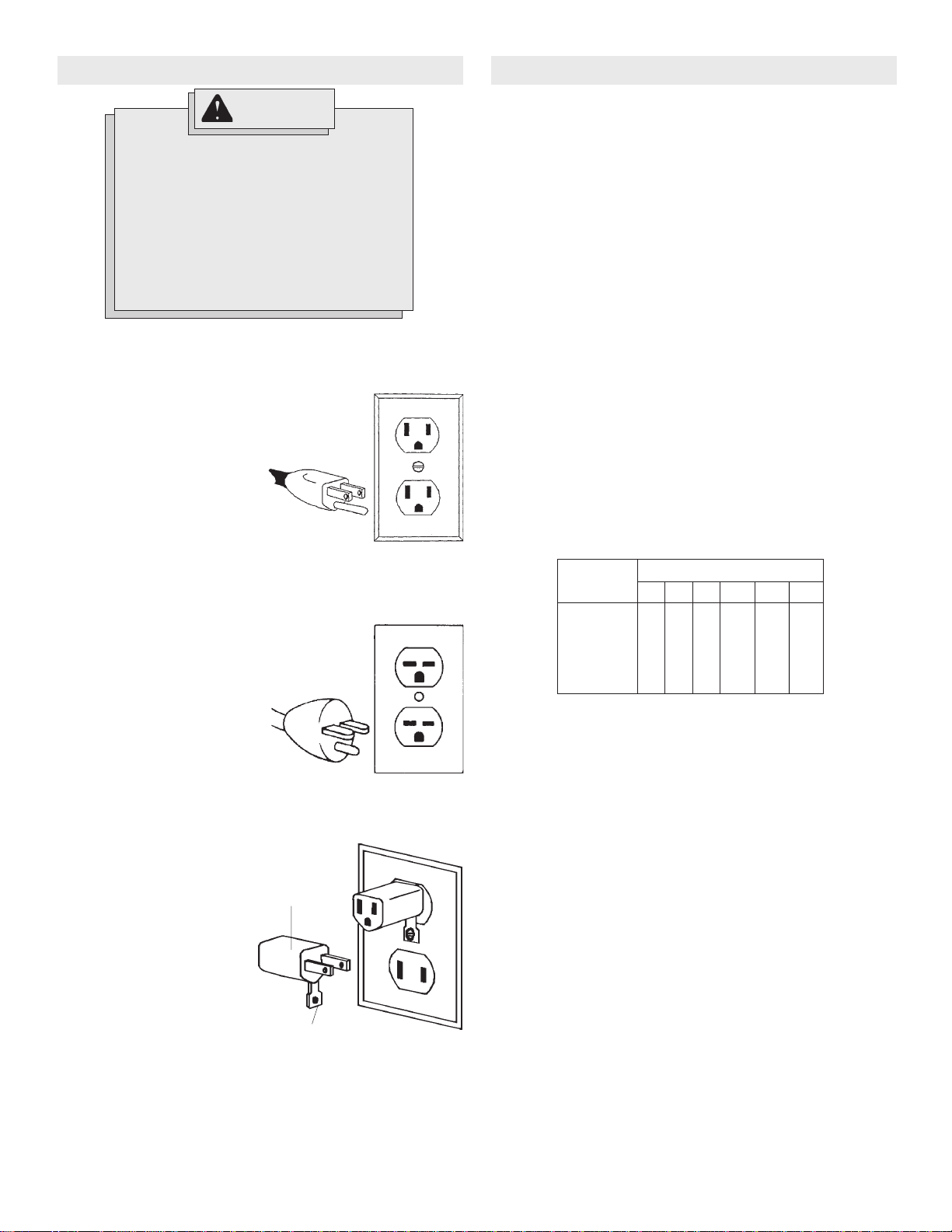
Grounded Tools:
Tools with Three Prong Plugs
Tools marked “Grounding Re-
quired” have a three wire cord and
three prong grounding plug. The
plug must be connected to a prop-
erly grounded outlet (See Figure A
and B). If the tool should electri-
cally malfunction or break down,
grounding provides a low resis-
tance path to carry electricity away
from the user, reducing the risk of
electric shock.
The grounding prong in the plug is
connected through the green wire
inside the cord to the grounding
system in the tool. The green wire
in the cord must be the only wire
connected to the tool's grounding
system and must never be attached
to an electrically “live” terminal.
Your tool must be plugged into an
appropriate outlet, properly in-
stalled and grounded in accor-
dance with all codes and ordi-
nances. If the plug and outlet look
like those in Figure A, your tool is
rated for use on less than 150
volts. If your plug and outlet look
like those in Figure B, your tool is
rated for use on 150 to 250 volts.
Temporary adapters are not avail-
able for this type of plug.
Figure C illustrates a temporary
adapter available for connecting
grounded plugs (Figure A) to two
prong outlets. The green rigid ear
or lug extending from the adapter
must be connected to a permanent
ground such as a properly
grounded outlet box or receptacle.
Simply remove the center screw
from the outlet, insert the adapter
and reattach the screw through
the green grounding ear to the out-
let. If in doubt of proper grounding,
call a qualified electrician. A tem-
porary adapter should only be
used until a properly grounded
outlet can be installed by a quali-
fied electrician. The Canadian Elec-
trical Code prohibits the use of
temporary adapters.
Fig. A
Fig. B
EXTENSION CORDS
Nameplate
Amperes
0 - 5
5.1 - 8
8.1 - 12
12.1 - 15
15.1 - 20
Extension Cord Length
25'
16
16
14
12
10
75'
16
14
12
10
10
100'
14
12
10
10
--
150'
12
10
--
--
--
200'
12
--
--
--
--
Recommended Minimum Wire Gauge
for Extension Cords*
* Based on limiting the line voltage drop to five
volts at 150% of the rated amperes.
50'
16
16
14
12
10
Improperly connecting the grounding wire can
result in the risk of electric shock. Check with a
qualified electrician if you are in doubt as to
whether the outlet is properly grounded. Do not
modify the plug provided with the tool. Never
remove the grounding prong from the plug. Do
not use the tool if the cord or plug is damaged. If
damaged, have it repaired by a
MILWAUKEE
service facility before use. If the plug will not fit
the outlet, have a proper outlet installed by a
qualified electrician.
WARNING!
Fig. C
Temporary
Adapter
Green Grounding Ear
Descargue el manual en Español (PDF, 0.28 MB)
(Piense en el medioambiente y solo imprima este manual si es de verdad necesario)

Loading…

Puntuación

Dé su opinión de la Milwaukee 4995 Amoladora de banco calificando el producto. ¿Quiere compartir su experiencia con este producto o hacer una pregunta? Deje un comentario en la parte inferior de la página.
¿Estás satisfecho con elMilwaukee 4995 Amoladora de banco?
No
Sea el primero en calificar este producto
0 votos

Únase a la conversación sobre este producto

Aquí puedes compartir lo que piensas sobre Milwaukee 4995 Amoladora de banco. Si tiene alguna pregunta, primero lea atentamente el manual. Puede solicitar un manual utilizando nuestro formulario de contacto.

Más sobre este manual

Entendemos que es bueno tener un manual en papel para tus Milwaukee 4995 Amoladora de banco. Siempre puedes descargar el manual desde nuestro sitio web e imprimirlo tú mismo. Si deseas tener un manual original te recomendamos contactar con Milwaukee. Es posible que puedan proporcionar un manual original. ¿Estás buscando el manual de tu Milwaukee 4995 Amoladora de banco en otro idioma? Elija su idioma preferido en nuestra página de inicio y busque el número de modelo para ver si lo tenemos disponible.

Especificaciones

Marca Milwaukee
Modelo 4995
Categoría Amoladoras de banco
Tipo de archivo PDF
Tamaño del archivo 0.28 MB

Todos los manuales para Milwaukee Amoladoras de banco
Más manuales de Amoladoras de banco

Preguntas frecuentes sobre Milwaukee 4995 Amoladora de banco

Nuestro equipo de atención al cliente busca información útil sobre los productos y responde a las preguntas frecuentes. Si encuentra inexactitudes en las preguntas frecuentes, indíquenoslo usando nuestro formulario de contacto.

¿Puedo guardar herramientas eléctricas en un cobertizo o garaje? Verificado

En general, las herramientas eléctricas se pueden guardar en un cobertizo o en un garaje, aunque a veces haga frío allí. Sin embargo, para prolongar la vida útil de la herramienta eléctrica, es mejor guardarla en un lugar seco y sin grandes fluctuaciones de temperatura. En un cobertizo o garaje, las diferencias de temperatura pueden provocar la formación de condensación, lo que puede provocar oxidación. Además, las herramientas que funcionan con baterías duran menos y no se cargan tan bien a temperaturas muy bajas. Para estar seguro de cómo debe almacenarse su herramienta eléctrica, lea siempre detenidamente el manual del usuario.

Ha sido de gran ayuda (11) Leer más
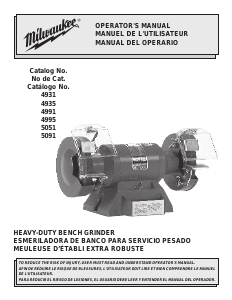
Manual de uso Milwaukee 4995 Amoladora de banco

Productos relacionados

Categorias relacionadas

×
Download