Manual de uso Pioneer S-81-K Altavoz

¿Necesita un manual para su Pioneer S-81-K Altavoz? A continuación puedes ver y descargar el manual en PDF gratis en español. Este producto actualmente tiene 5 preguntas frecuentes, 0 comentarios y tiene 0 votos. Si este no es el manual que desea, , contáctenos.

¿Su producto tiene algún defecto y el manual no ofrece ninguna solución? Vaya a Repair Café para solicitar un servicio de reparación gratuito.

Manual de uso

Loading…
4
En
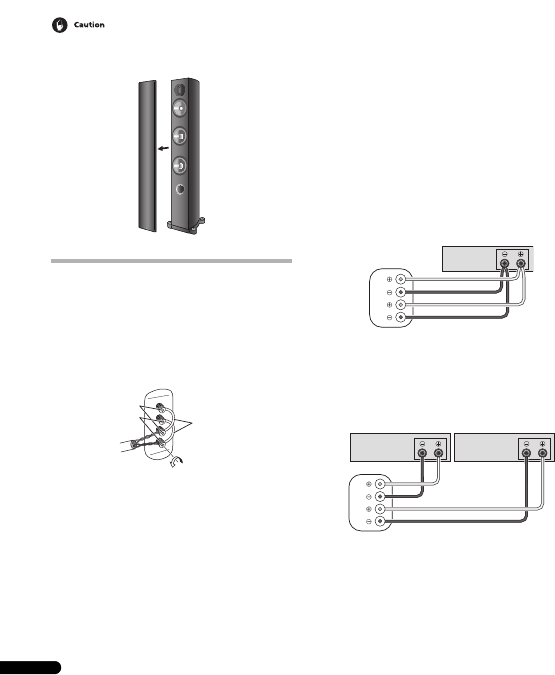
Attaching/removing the grille
This speaker system comes with grille which may be attached and
removed by:
1 To attach the grille, align the grille with the speaker body
and press gently.
2 To remove the grille, hold the grille with both hands near
the middle and pull gently toward you to separate the grille
from the speaker.
Magnets are used for holding the grille in place. Do not place
the grilles near devices that may be susceptible to magnetic
influence (CRT televisions, etc.).
Connections
This speaker does not include speaker cables used for connecting
to an amplifier.
Connecting the cables
1 Switch off the power to your amplifier.
2 Connect the speaker cables to the input terminals (lower)
on the back of the speaker. For input terminal polarity, red is
positive (+) and black is negative (–).
3 Connect the other ends of the cables to the amp's
speaker output terminals (for more details, refer to your amp
instruction manual).
Grasp the cap knobs on the lower input terminals and rotate
them to the left (counter-clockwise), insert the speaker cable
wires into the holes in the terminal posts, then tighten the
knobs to secure the short bar as well as the wires.
You can also connect the speaker’s terminals with a banana
plug. When using a banana plug, be sure to remove the cap at
the tip of the input terminal.
After connecting the plugs, pull lightly on the cables to make
sure that the ends of the cables are securely connected to the
terminals. Poor connections can create noise and
interruptions in the sound.
If the cables’ wires happen to be pushed out of the terminals,
allowing the wires to come into contact with each other, it
places an excessive additional load on the amp. This may
cause the amp to stop functioning, and may even damage the
amp.
When using a set of speakers connected to an amplifier, you
won’t be able to obtain the normal stereo effect if the polarity
(+, ) of one of the speakers (left or right) is reversed.
Bi-Wire connections
Bi-wiring requires two cables for each speaker, one for high
frequencies and one for low frequencies. Using separate cables
for the high end and low end improves the sound.
1 Switch off the power to your amplifier.
2R
emove the two short bars.
In this state, the low-frequency speakers and the higher-
frequency speakers are completely independent. Store the
short bars in a safe place for later use.
The lower terminals are for the bass, and the upper terminals
are for midrange and treble sounds.
Connecting the cables with reversed polarity may degrade the
tone seriously. Confirm that the cables are connected
properly.
Bi-Amplification connections
Bi-amping is an even more powerful way of connecting your
speakers. Just as with bi-wiring, the input terminal short bars are
removed, but here the low-frequency terminals are connected to a
separate, dedicated low-frequency amp, and the high-frequency
terminals are connected to a dedicated high-frequency amp.
Short bar connectors
Red terminal
(+)
Black terminal
()
CAUTION
T
hese speaker terminals carry HAZARDOUS LIVE
voltage. To prevent the risk of electric shock when
connecting or disconnecting the speaker cables,
disconnect the power cord before touching any
uninsulated parts.
D3-4-2-2-3_A_En
SPEAKERS OUTPUT
HF
HF
LF
LF
Speaker
Amplifier (rear)
(Only one channel shown)
Speaker (rear): Input panel
SPEAKERS OUTPUT
HF
HF
LF
LF
SPEAKERS OUTPUT
(Only one channel shown) (Only one channel shown)
Amplifier (rear)
(High frequency)
Amplifier (rear)
(Low frequency)
Speaker
Speaker (rear): Input panel
FRRD-232-A_S-81_En.book 4 ページ 2008年7月22日 火曜日 午後2時26分
Descargue el manual en Español (PDF, 7.4 MB)
(Piense en el medioambiente y solo imprima este manual si es de verdad necesario)

Loading…

Puntuación

Dé su opinión de la Pioneer S-81-K Altavoz calificando el producto. ¿Quiere compartir su experiencia con este producto o hacer una pregunta? Deje un comentario en la parte inferior de la página.
¿Estás satisfecho con elPioneer S-81-K Altavoz?
No
Sea el primero en calificar este producto
0 votos

Únase a la conversación sobre este producto

Aquí puedes compartir lo que piensas sobre Pioneer S-81-K Altavoz. Si tiene alguna pregunta, primero lea atentamente el manual. Puede solicitar un manual utilizando nuestro formulario de contacto.

Más sobre este manual

Entendemos que es bueno tener un manual en papel para tus Pioneer S-81-K Altavoz. Siempre puedes descargar el manual desde nuestro sitio web e imprimirlo tú mismo. Si deseas tener un manual original te recomendamos contactar con Pioneer. Es posible que puedan proporcionar un manual original. ¿Estás buscando el manual de tu Pioneer S-81-K Altavoz en otro idioma? Elija su idioma preferido en nuestra página de inicio y busque el número de modelo para ver si lo tenemos disponible.

Especificaciones

Marca Pioneer
Modelo S-81-K
Categoría Altavoces
Tipo de archivo PDF
Tamaño del archivo 7.4 MB

Todos los manuales para Pioneer Altavoces
Más manuales de Altavoces

Preguntas frecuentes sobre Pioneer S-81-K Altavoz

Nuestro equipo de atención al cliente busca información útil sobre los productos y responde a las preguntas frecuentes. Si encuentra inexactitudes en las preguntas frecuentes, indíquenoslo usando nuestro formulario de contacto.

Quiero conectar un altavoz a mi televisor con HDMI. ¿Qué puerto debo usar? Verificado

Debe usar el puerto HDMI-ARC, que está hecho específicamente para conectar equipos de audio.

Ha sido de gran ayuda (1488) Leer más

¿Qué indican las frecuencias sobre mi altavoz? Verificado

Indican el rango de frecuencias que el altavoz puede producir. Una gama más amplia de frecuencias proporcionará una mayor variación en el sonido y producirá un sonido de mayor calidad.

Ha sido de gran ayuda (795) Leer más

¿Cuándo está la música demasiado alta? Verificado

El sonido por encima de los 80 decibelios (dB) puede causar daños en la audición. Los sonidos por encima de 120 dB dañan la audición de forma inmediata. La gravedad de los daños depende de la frecuencia y la duración del sonido.

Ha sido de gran ayuda (477) Leer más

¿El bluetooth funciona a través de paredes y techos? Verificado

Una señal bluetooth funcionará a través de paredes y techo, a menos que estén hechos de metal. Dependiendo del grosor y del material de la pared, la señal puede perder fuerza.

Ha sido de gran ayuda (238) Leer más

¿Hasta qué nivel es seguro el ruido para los niños? Verificado

Los niños se dañan los oídos antes que los adultos. Por lo tanto, nunca exponga a los niños a un ruido superior a 85 dB. En el caso de los auriculares hay modelos especiales para niños. Con altavoces u en otras situaciones hay que estar atento para que el ruido no supere ese nivel.

Ha sido de gran ayuda (212) Leer más
Manual de uso Pioneer S-81-K Altavoz

Productos relacionados

Categorias relacionadas

×
Download