it in its place, while the carbon filter can be freed by turning counter
clockwise.
The external parts of the cooker hood should be cleaned by using a
damp sponge and liquid neutral detersive or a cloth dipped in neutralised
alcohol.
Please avoid cleaning products that contain scouring agents.
Security regulations
Cooking «en flambe» under the cooker hood is forbidden. When frying,
constant watch must be given to all aspects of the ope-ration in particular
because oil heated to a high temperature becomes inflammable easily.
Frequent cleaning, in particular of the fan and the surfaces of the cooker
hood, will avoid the risk of fire. The cleaning can be done with a cloth
or small brush dipped in ethyl alcohol. Furthermore it is important to
replace frequently each of the filters fitted in the cooker hood.
Suggestions for the use in extraction mode (exhaust version)
When the cooker hood is used in the extraction mode it is advisable
to give particular attention to appliances and sources of heating at the
same time in use (e.g. gas and oil heaters, coal or coke fires etc.)
because the cooker hood sucks in the air which is needed for
combustion by the above mentioned appliances causing a depression.
During simultaneous use of heating appliances and cooker hood a max.
depression of 0,04 mbar is advisable. In these conditions the risk of
drawing in gases from heating appliances is avoided. This can be
obtained by openings which cannot be closed e.g. in doors and windows
or by other technical means. From these openings sufficient fresh air
for combustion should be able to enter.
Attention: To assess the situation fully all flues and vents in the
apartment should be taken into consideration. If there is any doubt then
it is advisable to obtain the approval of the responsible agency for the
building. These precautions are not required when the cooker hood is
used in the filtering version with carbon filter fitted.
INSTALLATION AND USER INSTRUCTIONS FOR COOKER HOOD
TYPE "TL18GR"
These instructions should be read carefully before the installation
is done
Your new cooker hood can be used in the following ways:
Extraction (exhaust mode)
In this case it is necessary to connect the hood to a tube (Ø 100“125
mm.) by using the connection piece which is supplied. The extracted
air is then expelled to the outside.
Recirculation (filtering mode)
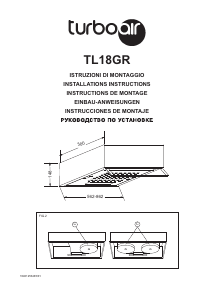
The air is purified by means of an active carbon filter (odour filter - Fig.2/
C) and then returned into the room.
Summer/Winter use
To avoid loss of heat in winter it is advisable to use the hood as a
recirculation hood. Warm air is purified and then re-distributed into the
room. Cooker hoods which are installed as extraction hoods are easily
changed to recirculation hoods and vice-versa.
Installation
The cooker hood must be fixed directly under a kitchen unit, furthermore
it must be installed centrally above the cooking hob. The minimum
distance between the hob and the lower part of the cooker hood must
be 650 mm.
N.B. The above distance is subject to regulations in force for security
in the respective countries.
Extraction Hood
When used in the extraction mode following points should be considered:
The exhausted air should not be conducted in a chimney with warm air
circulation. Do not connect the appliance to fuel exhaust flues or ventilating
ducts. With venting into exhaust flues or ventilating ducts wich are no
longer in use, it is advisable to obtain the approval of the responsible
agency for the building. In the extraction mode the air is exhausted and
conveyed through the ventilating duct upwards or directly to the outside.
Attention: The shorter the exhaust duct is and the fewer bends there
are in it, the more effective will the cooker hood be.
Recirculation Hood
When the hood is used in the recirculation mode and fitted with a carbon
filter there is no need to connect the device (connection piece) to the
tube.
Installation under a Kitchen Unit
N.B. Check that the unit is able to support the weight of the cooker
hood.
Turn the unit upside-down.
Mark the holes for the screws.
Corresponding to the air-outlet a hole for the connection piece of Ø 104/
140 mm must be provided on the kitchen unit (for spigot of Ø 100/125
mm).
Drill the holes for fixing the hood with a Ø 5 mm drill-bit.
Lean the unit against the top part of the cooker hood and tighten it up
to the hood with the 4 self-threading screws.
Connecting to mains supply
Check that the mains supply is the same as that on the technical data
plate which is attached to the cooker hood.
Attention: If the appliance has no plug an allpole separation must be
provided in the separation of the net with a minimum contact width of
3 mm each pole.
Note — A damaged power supply cord must be changed by the
Service because require a special tool.
Maintenance
N.B. Before any repairs, servicing or cleaning is carried out the plug
must be disconnected.
The grease filter should be washed every 10-15 days in hot water with
detersive. It absorbs the particles of fat which become present during
cooking and protects the kitchen and its furniture from deposits of
grease. After successive washings however it should be replaced.
The carbon filter functions during any type of cooking and is highly
effective removing cooking smells and particles of grease which otherwise
would be deposited on the walls and the fur-niture. Carbon filters cannot
be washed. It is advisable to replace them every six months, depending
on how frequently the hood is in use.
In order to replace the filters mentioned above it is sufficient to open
the grid of the cooker hood by pushing the fixing devices one towards
the other pulling the grid outside until the control board is freed. The
grease filter can be taken off by removing the retaining clips that hold


Únase a la conversación sobre este producto
Aquí puedes compartir lo que piensas sobre Turboair TL18 Campana extractora. Si tiene alguna pregunta, primero lea atentamente el manual. Puede solicitar un manual utilizando nuestro formulario de contacto.