Manual de uso Hikoki DS 9DVF3 Atornillador taladrador

¿Necesita un manual para su Hikoki DS 9DVF3 Atornillador taladrador? A continuación puedes ver y descargar el manual en PDF gratis en español. Este producto actualmente tiene 3 preguntas frecuentes, 0 comentarios y tiene 0 votos. Si este no es el manual que desea, , contáctenos.

¿Su producto tiene algún defecto y el manual no ofrece ninguna solución? Vaya a Repair Café para solicitar un servicio de reparación gratuito.

Manual de uso

Loading…
4
English
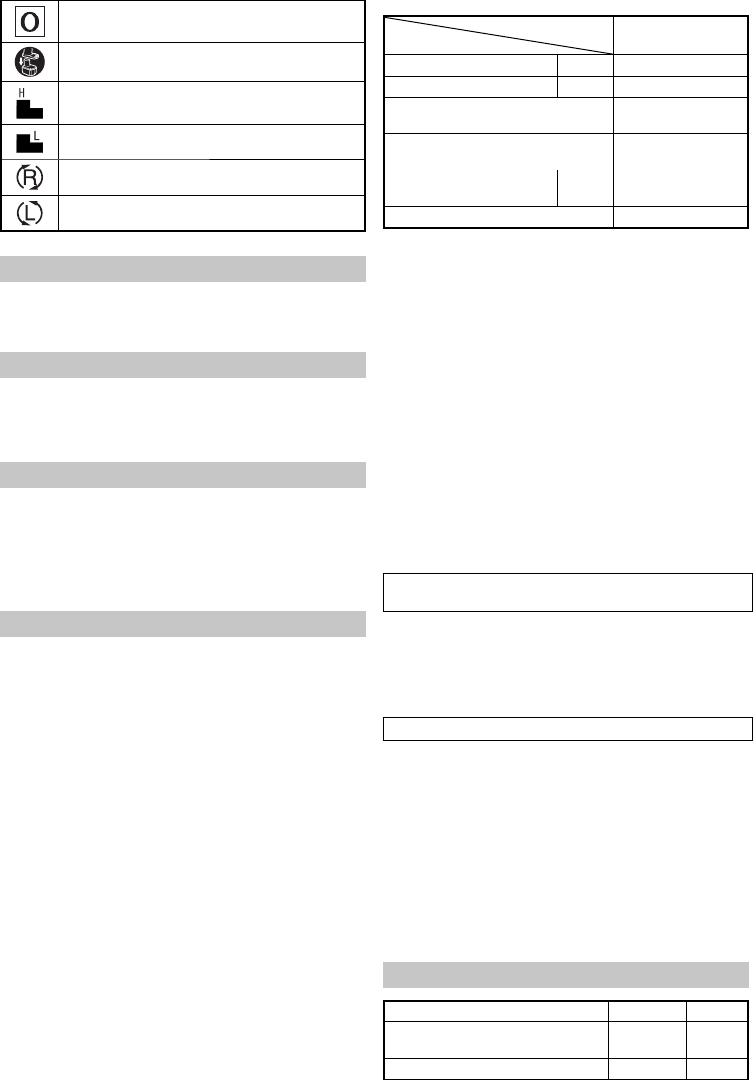
Switching OFF
Disconnect the battery
Change rotation speed - High speed
Change rotation speed - Low speed
Clockwise rotation
Counterclockwise rotation
STANDARD ACCESSORIES
In addition to the main unit (1 unit), the package contains the
accessories listed on page 114.
Standard accessories are subject to change without notice.
APPLICATIONS
Driving and removing of machine screws, wood screws,
tapping screws, etc.
Drilling of various metals
Drilling of various woods
SPECIFICATIONS
The speci cations of this machine are listed in the Table on
page 114.
NOTE
Due to HiKOKI’s continuing program of research and
development, the speci cations herein are subject to
change without prior notice.
CHARGING
Before using the power tool, charge the battery as follows.
1. Connect the charger’s power cord to the receptacle.
2. Insert the battery into the charger. (Fig. 2)
Insert the battery rmly while observing its direction, until
it contacts the bottom of the charger (the pilot lamp lights
up).
CAUTION
If the pilot lamp does not light up, pull out the power
cord from the receptacle and check the battery
mounting condition.
If the battery is heated due to direct sunlight, etc.,
just after operation, the charger pilot lamp may not
light up. At that time, cool the battery rst, then start
charging.
Regarding the temperatures and charging time of the
battery.
The temperatures and charging time will become as
shown in Table 1
Table 1
Charger
Battery
UC18YG
Charging voltage V 7.2 18
Weight kg 0.3
Temperatures at which the battery
can be recharged
0oC 40oC
Charging time for battery capacity,
approx. (At 20oC)
1.2 1.5 Ah
2.0 Ah
min.
min.
30
50
Number of battery cells 8 15
NOTE
The recharging time may vary according to the ambient
temperature and power source voltage.
CAUTION
Always charge the battery at a temperature of 10°C –
40°C. A temperature of less than 10°C will result in over
charging which is dangerous. The battery cannot be
charged at a temperature higher than 40°C.
When one charging is completed, leave the charger for
about 15 minutes before the next charging of battery.
When the pilot lamp does not go o even if more than 120
minutes have elapsed after starting of the charging, stop
the charging and contact your HiKOKI AUTHORIZED
SERVICE CENTER.
3. The pilot lamp goes o to indicate that the battery is
fully charged.
4. Disconnect the charger’s power cord from the
receptacle.
5. Hold the charger rmly and pull out the battery.
NOTE
Be sure to pull out the battery from the charger after use,
and then keep it.
Regarding electric discharge in case of new batteries,
etc.
As the internal chemical substance of new batteries and
batteries that have not been used for an extended period
is not activated, the electric discharge might be low when
using them the rst and second time. This is a temporary
phenomenon, and normal time required for recharging
will be restored by recharging the batteries 2 – 3 times.
How to make the batteries perform longer.
(1) Recharge the batteries before they become completely
exhausted.
When you feel that the power of the tool becomes
weaker, stop using the tool and recharge its battery. If
you continue to use the tool and exhaust the electric
current, the battery may be damaged and its life will
become shorter.
(2) Avoid recharging at high temperatures.
A rechargeable battery will be hot immediately after
use. If such a battery is recharged immediately after
use, its internal chemical substance will deteriorate, and
the battery life will be shortened. Leave the battery and
recharge it after it has cooled for a while.
MOUNTING AND OPERATION
Action Figure Page
Removing and inserting the
battery
1 115
Charging 2 115
0000Book̲DS9DVF3.indb40000Book̲DS9DVF3.indb4 2017/12/048:51:072017/12/048:51:07
Descargue el manual en Español (PDF, 10.1 MB)
(Piense en el medioambiente y solo imprima este manual si es de verdad necesario)

Loading…

Puntuación

Dé su opinión de la Hikoki DS 9DVF3 Atornillador taladrador calificando el producto. ¿Quiere compartir su experiencia con este producto o hacer una pregunta? Deje un comentario en la parte inferior de la página.
¿Estás satisfecho con elHikoki DS 9DVF3 Atornillador taladrador?
No
Sea el primero en calificar este producto
0 votos

Únase a la conversación sobre este producto

Aquí puedes compartir lo que piensas sobre Hikoki DS 9DVF3 Atornillador taladrador. Si tiene alguna pregunta, primero lea atentamente el manual. Puede solicitar un manual utilizando nuestro formulario de contacto.

Más sobre este manual

Entendemos que es bueno tener un manual en papel para tus Hikoki DS 9DVF3 Atornillador taladrador. Siempre puedes descargar el manual desde nuestro sitio web e imprimirlo tú mismo. Si deseas tener un manual original te recomendamos contactar con Hikoki. Es posible que puedan proporcionar un manual original. ¿Estás buscando el manual de tu Hikoki DS 9DVF3 Atornillador taladrador en otro idioma? Elija su idioma preferido en nuestra página de inicio y busque el número de modelo para ver si lo tenemos disponible.

Especificaciones

Marca Hikoki
Modelo DS 9DVF3
Categoría Atornilladores taladrador
Tipo de archivo PDF
Tamaño del archivo 10.1 MB

Todos los manuales para Hikoki Atornilladores taladrador
Más manuales de Atornilladores taladrador

Preguntas frecuentes sobre Hikoki DS 9DVF3 Atornillador taladrador

Nuestro equipo de atención al cliente busca información útil sobre los productos y responde a las preguntas frecuentes. Si encuentra inexactitudes en las preguntas frecuentes, indíquenoslo usando nuestro formulario de contacto.

Sigo quitando la cabeza del tornillo cuando uso el destornillador. ¿Porqué es eso? Verificado

La mayoría de los destornilladores pueden configurarse para atornillar más fuerte o más suave. Si la cabeza sigue siendo despojada, el taladro-destornillador probablemente debería colocarse en una configuración diferente. Cuando se trata de un dispositivo inalámbrico, asegúrese siempre de que la batería esté cargada para obtener un resultado óptimo.

Ha sido de gran ayuda (96) Leer más

¿Necesito usar protección auditiva cuando utilizo un taladro? Verificado

Si deberías. Aunque la cantidad de ruido producido por un taladro puede variar entre marcas y modelos, la exposición prolongada a ruidos fuertes puede causar daños auditivos permanentes. Por eso es una buena idea usar protección auditiva.

Ha sido de gran ayuda (37) Leer más

¿Puedo guardar herramientas eléctricas en un cobertizo o garaje? Verificado

En general, las herramientas eléctricas se pueden guardar en un cobertizo o en un garaje, aunque a veces haga frío allí. Sin embargo, para prolongar la vida útil de la herramienta eléctrica, es mejor guardarla en un lugar seco y sin grandes fluctuaciones de temperatura. En un cobertizo o garaje, las diferencias de temperatura pueden provocar la formación de condensación, lo que puede provocar oxidación. Además, las herramientas que funcionan con baterías duran menos y no se cargan tan bien a temperaturas muy bajas. Para estar seguro de cómo debe almacenarse su herramienta eléctrica, lea siempre detenidamente el manual del usuario.

Ha sido de gran ayuda (29) Leer más
Manual de uso Hikoki DS 9DVF3 Atornillador taladrador

Productos relacionados

Categorias relacionadas

×
Download