Manual de uso Makita DUH501Z Tijeras cortasetos

¿Necesita un manual para su Makita DUH501Z Tijeras cortasetos? A continuación puedes ver y descargar el manual en PDF gratis en español. Este producto actualmente tiene 4 preguntas frecuentes, 0 comentarios y tiene 0 votos. Si este no es el manual que desea, , contáctenos.

¿Su producto tiene algún defecto y el manual no ofrece ninguna solución? Vaya a Repair Café para solicitar un servicio de reparación gratuito.

Manual de uso

Loading…
12 ENGLISH
NOTICE: Depending on the usage conditions,
the tool is automatically turned off without any
indication if the tool is overloaded by entangled
branches or debris. In this case, switch off the
tool and remove the battery cartridge, and then
remove entangled branches or debris using tools
such as pliers. After removing the branches or
debris, install the battery cartridge and turn on
the tool again.
Overheat protection for tool or battery
There are two types of overheating; tool overheating
and battery overheating. When the tool over heating
occurs, all speed indicators blink. When the battery over
heating occurs, indicator blinks.
If the overheating occurs, the tool stops automatically.
Let the tool and/or battery cool down before turning the
tool on again.
Overdischarge protection
When the battery capacity becomes low, the tool stops
automatically and indicator blinks.
If the tool does not operate even when the switches are
operated, remove the battery from the tool and charge
the battery.
Angle setting of the handle
CAUTION: Always make sure that the handle
is locked in the desired position before operation.
CAUTION: Do not pull down the lever to
unlock the handle while pulling the switch trigger.
Do not pull the switch trigger while pulling down
the lever and turning the handle. Failure to do so
may cause a malfunction of the tool.
You can set the angle of the handle to 0°, 45°, or 90°
to the left or right. To change the angle of the handle,
turn the handle while pulling down the lever, and then
release the lever.
Fig.3: 1. Lever
Power switch action
WARNING: For your safety, this tool is
equipped with lock-off lever which prevents the
tool from unintended starting. NEVER use the tool
if it runs when you simply press the switch lever
and pull the switch trigger without pressing the
lock-off lever. Return the tool to our authorized
service center for proper repairs BEFORE further
usage.
WARNING: NEVER tape down or defeat pur-
pose and function of lock-off lever.
WARNING: Before installing the battery car-
tridge on the tool, always check to see that the
switch trigger and switch lever actuate properly
and return to the "OFF" position when released.
Operating a tool with a switch that does not actuate
properly can lead to loss of control and serious per-
sonal injury.
CAUTION: Never put your nger on the
switch when carrying. The tool may start uninten-
tionally and cause injury.
NOTICE: Do not pull the switch trigger hard with-
out pressing the lock-off lever. This can cause
switch breakage.
Press and hold the main power button to turn on the
tool. The power lamp lights up when the tool is turned
on. To turn off the tool, press and hold the main power
button again. The power lamp goes off when the tool is
turned off.
Fig.4: 1. Power lamp 2. Main power button
NOTE: The tool is automatically turned off if the tool is
not operated for a certain period.
To prevent the switch trigger from being accidentally
pulled, a lock-off lever is provided. To start the tool,
depress the lock-off lever, and then press the switch
lever and pull the switch trigger. The tool speed
increases by increasing pressure on the switch trigger.
Release the switch trigger to stop.
Fig.5: 1. Switch lever 2. Lock-off lever 3. Switch
trigger
Speed adjusting
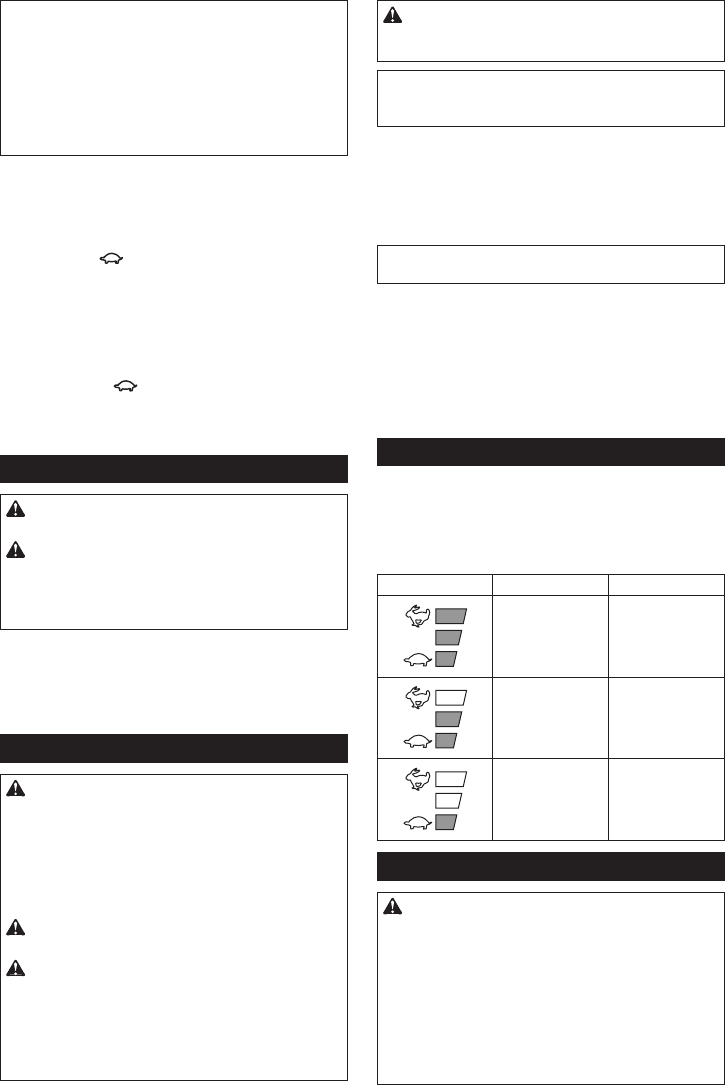
You can adjust the tool speed by tapping the main
power button.
Each time you tap the main power button, the level of
speed will change.
Fig.6: 1. Power lamp 2. Main power button
Indicator Mode Stroke speed
High 4,400 min
-1
Medium 3,600 min
-1
Low 2,000 min
-1
Reverse button for debris removal
WARNING: If the entangled branches or
debris cannot be removed by the reverse func-
tion, switch off the tool and remove the bat-
tery cartridge, and then remove the entangled
branches or debris using tools such as pliers.
Failure to switch off the tool and remove the bat-
tery cartridge may result in serious personal injury
from accidental start-up. Removing the entangled
branches or debris by hand may cause an injury,
since the shear blades may move in reaction to
removing them.
Descargue el manual en Español (PDF, 19.78 MB)
(Piense en el medioambiente y solo imprima este manual si es de verdad necesario)

Loading…

Puntuación

Dé su opinión de la Makita DUH501Z Tijeras cortasetos calificando el producto. ¿Quiere compartir su experiencia con este producto o hacer una pregunta? Deje un comentario en la parte inferior de la página.
¿Estás satisfecho con elMakita DUH501Z Tijeras cortasetos?
No
Sea el primero en calificar este producto
0 votos

Únase a la conversación sobre este producto

Aquí puedes compartir lo que piensas sobre Makita DUH501Z Tijeras cortasetos. Si tiene alguna pregunta, primero lea atentamente el manual. Puede solicitar un manual utilizando nuestro formulario de contacto.

Más sobre este manual

Entendemos que es bueno tener un manual en papel para tus Makita DUH501Z Tijeras cortasetos. Siempre puedes descargar el manual desde nuestro sitio web e imprimirlo tú mismo. Si deseas tener un manual original te recomendamos contactar con Makita. Es posible que puedan proporcionar un manual original. ¿Estás buscando el manual de tu Makita DUH501Z Tijeras cortasetos en otro idioma? Elija su idioma preferido en nuestra página de inicio y busque el número de modelo para ver si lo tenemos disponible.

Especificaciones

Marca Makita
Modelo DUH501Z
Categoría Tijeras cortasetos
Tipo de archivo PDF
Tamaño del archivo 19.78 MB

Todos los manuales para Makita Tijeras cortasetos
Más manuales de Tijeras cortasetos

Preguntas frecuentes sobre Makita DUH501Z Tijeras cortasetos

Nuestro equipo de atención al cliente busca información útil sobre los productos y responde a las preguntas frecuentes. Si encuentra inexactitudes en las preguntas frecuentes, indíquenoslo usando nuestro formulario de contacto.

¿Cómo sé que mi cortasetos no tiene filo? Verificado

Cuando se arrancan ramas en lugar de cortarlas, el cortasetos está desafilado y debe afilarse.

Ha sido de gran ayuda (346) Leer más

¿Cómo afilo las cuchillas de mi cortasetos? Verificado

Afilar las cuchillas de su cortadora de setos es importante para mantener el rendimiento y la eficiencia de la herramienta. Para afilar las cuchillas, necesitará una lima o una piedra de afilar diseñada específicamente para el tipo de cuchilla de su cortasetos.

Ha sido de gran ayuda (299) Leer más

¿Cómo lubrico las cuchillas de mi cortasetos? Verificado

Lubricar las cuchillas de su cortadora de setos ayudará a reducir la fricción y el desgaste, prolongando la vida útil de la herramienta. Utilice un aceite lubricante de alta calidad diseñado específicamente para cortasetos y aplique una pequeña cantidad a las cuchillas después de cada uso.

Ha sido de gran ayuda (147) Leer más

¿Cómo puedo evitar que se forme óxido en las hojas de mi cortasetos? Verificado

El óxido puede dañar las cuchillas de su cortadora de setos, reduciendo su rendimiento y vida útil. Para evitar la oxidación, limpie y seque bien las cuchillas después de cada uso y guárdelas en un lugar seco y limpio. También puede considerar aplicar una capa protectora, como aceite o un inhibidor de óxido, a las cuchillas antes de guardarlas.

Ha sido de gran ayuda (90) Leer más


Manual de uso Makita DUH501Z Tijeras cortasetos

Productos relacionados

Categorias relacionadas

×
Download