Manual de uso Makita DUH501Z Tijeras cortasetos

¿Necesita un manual para su Makita DUH501Z Tijeras cortasetos? A continuación puedes ver y descargar el manual en PDF gratis en español. Este producto actualmente tiene 4 preguntas frecuentes, 0 comentarios y tiene 0 votos. Si este no es el manual que desea, , contáctenos.

¿Su producto tiene algún defecto y el manual no ofrece ninguna solución? Vaya a Repair Café para solicitar un servicio de reparación gratuito.

Manual de uso

Loading…
13 ENGLISH
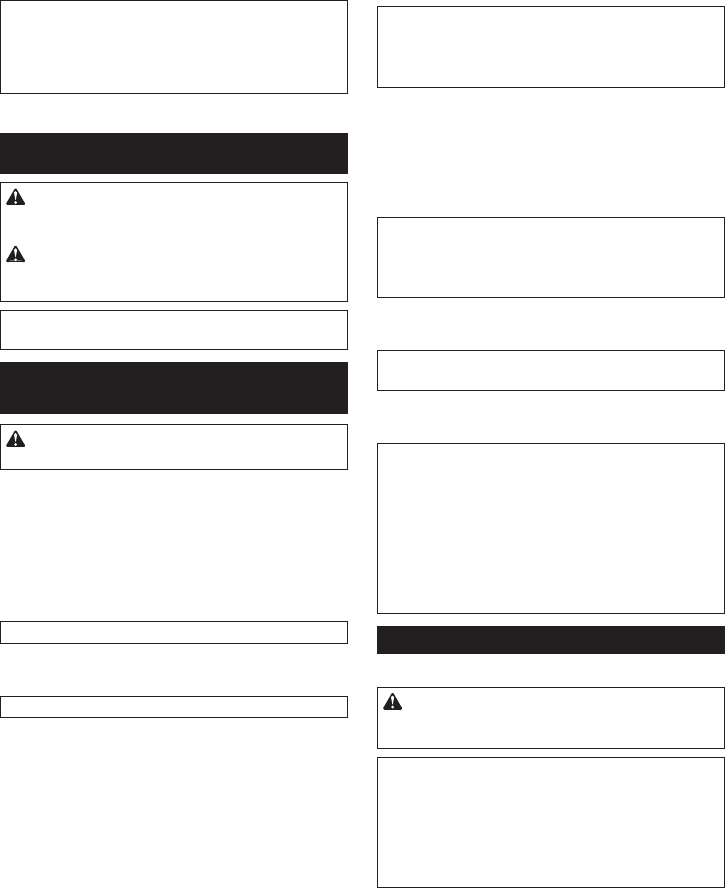
This tool has a reverse button to change the direction
of shear blades movement. It is only for removing
branches and debris entangled in the tool.
To reverse the shear blades movement, tap the reverse
button when the shear blades have stopped, then press
the switch lever and pull the switch trigger while press-
ing the lock-off lever. The power lamp starts blinking,
and the shear blades move in reverse direction.
When entangled branches and debris are removed,
the tool returns to the regular movement and the power
lamp stops blinking and lights up.
Fig.7: 1. Reverse button
NOTE:
If the entangled branches or debris cannot be removed,
release and pull the switch trigger until they are removed.
NOTE: If you tap the reverse button while the shear
blades are still moving, the tool comes to stop and to
be ready for reverse movement.
ASSEMBLY
CAUTION: Always be sure that the tool is
switched off and the battery cartridge is removed
before carrying out any work on the tool.
CAUTION: When replacing the shear blades,
always wear gloves so that your hands do not
directly contact the blades.
NOTICE: When replacing the shear blades, do
not wipe off grease from the gear and crank.
Installing or removing the shear
blades
CAUTION: Attach the blade cover before
removing or installing the shear blades.
You can install 500 mm, 600 mm, or 750 mm shear
blades to your tool.
1. Place the tool upside down, and then remove 6
screws.
Fig.8: 1. Screw
2. Remove the cover and the plate.
Fig.9: 1. Cover 2. Plate
NOTE: The plate may remain on the cover.
3. Remove the rod.
Fig.10: 1. Rod
NOTE: The rod may remain on the cover.
4. Remove 2 screws, the felt pad, the washers, and
the sleeves, and then remove the shear blades.
Fig.11: 1. Felt pad 2. Screw 3. Washer 4. Sleeve
5. Shear blades
5. Remove the blade cover.
6. Attach the blade cover to the new shear blades.
7. Adjust the crank so that 2 holes are lined up on
the alignment line.
Fig.12: 1. Hole 2. Alignment line
8. Align the protrusions on the shear blades vertically
at the same position.
Fig.13: 1. Protrusion
9. Attach the felt pad to the shear blades.
Fig.14: 1. Felt pad
10. Insert the protrusion on the shear blades to the
hole on the rod, then align the position of the felt pad
with the holes on the tool, and then attach new sleeves
and washers.
Fig.15: 1. Protrusion 2. Hole 3. Felt pad 4. Washer
5. Sleeve
NOTICE: Apply a small amount of grease to the
inner periphery of the hole of the rod.
NOTICE: Be careful not to lose the washers and
the sleeves.
11. Align the holes on the shear blades with the holes
on the tool, and then tighten 2 screws to x the shear
blades.
Fig.16: 1. Screw 2. Hole
12. Attach the rod.
Fig.17: 1. Rod 2. Small hole
NOTICE: Apply a small amount of grease to the
inner periphery of the small hole of the rod.
NOTICE: Make sure that the protrusion on the
shear blades ts in the small hole on the rod.
13. Attach the plate.
Fig.18: 1. Protrusion 2. Plate
NOTICE: Make sure that the protrusion on the
shear blades ts in the hole on the plate.
14. Attach the cover, and then tighten 6 screws.
Fig.19: 1. Cover 2. Screw
NOTICE: Be sure to attach 2 long screws to the
center holes.
NOTICE: If the shear blades do not move
smoothly, the shear blades are not engaged with
the rods properly. Install the shear blades again.
NOTICE: If the parts other than the shear
blades such as the rods are worn out, ask Makita
Authorized Service Centers for parts replacement
or repairs.
Installing or removing the chip receiver
Optional accessory
CAUTION: When installing or removing the
chip receiver, always wear gloves so that your
hands do not directly contact the shear blades.
NOTICE: The blade cover cannot be installed if
the chip receiver is installed on the tool. Before
carrying or storing the tool, uninstall the chip
receiver, and then install the blade cover to avoid
blade exposure.
NOTICE: Be sure to remove the blade cover
before installing the chip receiver.
Descargue el manual en Español (PDF, 19.78 MB)
(Piense en el medioambiente y solo imprima este manual si es de verdad necesario)

Loading…

Puntuación

Dé su opinión de la Makita DUH501Z Tijeras cortasetos calificando el producto. ¿Quiere compartir su experiencia con este producto o hacer una pregunta? Deje un comentario en la parte inferior de la página.
¿Estás satisfecho con elMakita DUH501Z Tijeras cortasetos?
No
Sea el primero en calificar este producto
0 votos

Únase a la conversación sobre este producto

Aquí puedes compartir lo que piensas sobre Makita DUH501Z Tijeras cortasetos. Si tiene alguna pregunta, primero lea atentamente el manual. Puede solicitar un manual utilizando nuestro formulario de contacto.

Más sobre este manual

Entendemos que es bueno tener un manual en papel para tus Makita DUH501Z Tijeras cortasetos. Siempre puedes descargar el manual desde nuestro sitio web e imprimirlo tú mismo. Si deseas tener un manual original te recomendamos contactar con Makita. Es posible que puedan proporcionar un manual original. ¿Estás buscando el manual de tu Makita DUH501Z Tijeras cortasetos en otro idioma? Elija su idioma preferido en nuestra página de inicio y busque el número de modelo para ver si lo tenemos disponible.

Especificaciones

Marca Makita
Modelo DUH501Z
Categoría Tijeras cortasetos
Tipo de archivo PDF
Tamaño del archivo 19.78 MB

Todos los manuales para Makita Tijeras cortasetos
Más manuales de Tijeras cortasetos

Preguntas frecuentes sobre Makita DUH501Z Tijeras cortasetos

Nuestro equipo de atención al cliente busca información útil sobre los productos y responde a las preguntas frecuentes. Si encuentra inexactitudes en las preguntas frecuentes, indíquenoslo usando nuestro formulario de contacto.

¿Cómo sé que mi cortasetos no tiene filo? Verificado

Cuando se arrancan ramas en lugar de cortarlas, el cortasetos está desafilado y debe afilarse.

Ha sido de gran ayuda (346) Leer más

¿Cómo afilo las cuchillas de mi cortasetos? Verificado

Afilar las cuchillas de su cortadora de setos es importante para mantener el rendimiento y la eficiencia de la herramienta. Para afilar las cuchillas, necesitará una lima o una piedra de afilar diseñada específicamente para el tipo de cuchilla de su cortasetos.

Ha sido de gran ayuda (299) Leer más

¿Cómo lubrico las cuchillas de mi cortasetos? Verificado

Lubricar las cuchillas de su cortadora de setos ayudará a reducir la fricción y el desgaste, prolongando la vida útil de la herramienta. Utilice un aceite lubricante de alta calidad diseñado específicamente para cortasetos y aplique una pequeña cantidad a las cuchillas después de cada uso.

Ha sido de gran ayuda (147) Leer más

¿Cómo puedo evitar que se forme óxido en las hojas de mi cortasetos? Verificado

El óxido puede dañar las cuchillas de su cortadora de setos, reduciendo su rendimiento y vida útil. Para evitar la oxidación, limpie y seque bien las cuchillas después de cada uso y guárdelas en un lugar seco y limpio. También puede considerar aplicar una capa protectora, como aceite o un inhibidor de óxido, a las cuchillas antes de guardarlas.

Ha sido de gran ayuda (90) Leer más
Manual de uso Makita DUH501Z Tijeras cortasetos

Productos relacionados

Categorias relacionadas

×
Download